Cipac (Verg27r)
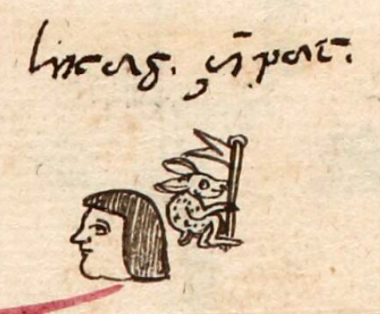
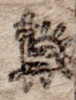
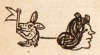
This compound Nahuatl hieroglyph is a black-line drawing of the personal name Cipac (“Crocodile”), attested here as a man’s name. It has two elements. On the left is a jack rabbit or hare (citli, or cihtli, with the glottal stop). It has long ears, and its coat is speckled. This animal provides the phonetic start to the name, Ci-. The animal seems to be holding onto a post with a swallowtail flag flying to the left. The flag (pamitl) provides the phonetic -pa- that forms the start of the second syllable of the name (-pac). Thus, this compound provides a fully phonetic spelling for Cipac, which is a name for an entirely different animal compared to what is pictured. Other Cipac compounds in this manuscript also use the hare and the flag (see folios 29 recto and 32 recto), providing no clue about the crocodile except in the gloss. Both of these latter hieroglyphs include the head of a woman (cihuatl), instead of the man who is named. The inclusion of a cihuatl seems to intend yet another phonetic complement for the Ci- start to the name.
Stephanie Wood
The name Cipac comes from the 260-day religious divinatory calendar. As is often the case, the companion number (1- 13) is not included. This may be owing to a facing tradition or to the opposition from the colonial clergy to the continued use of the divinatory calendar for naming babies. The writer may be disguising this usage, whether by not drawing a crocodile and/or omitting the number. Serious events in 1539 may have made Nahua tlacuilos more cautious when writing and painting about aspects of their faith. See Patricia Lopes Don for information about the Inquisition case against don Carlos Ometochtli, a Chichimecatecuhtli (or Chichimecateuctli) executed in late 1539, in Bonfires of Culture, 2010. Bradley Benton (The Lords of Tetzcoco, 2017, 46) also writes that the case “demonstrates that blatant disregard for Christianity had serious consequences.” Interestingly, the cipactli was apparently not well known in central Mexico, given the way many tlacuilos seemed at a loss to draw one. See a few examples below.
Stephanie Wood
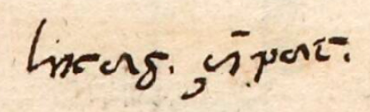
lucas.çipac
Lucas Cipac
Stephanie Wood
1539
Jeff Haskett-Wood
cocodrilos, liebre, liebres, bandera, banderas, calendario, calendarios, nombres de días, fonetismo, nombres de hombres, men’s names

cipac(tli), a crocodile, https://nahuatl.wired-humanities.org/content/cipactli
Cocodrilo
Stephanie Wood
Available at Codex Vergara, folio 27r, https://gallica.bnf.fr/ark:/12148/btv1b84528032/f61.item.zoom, accessed 22 February 2026. The Vergara is associated with Tepetlaoztoc, in the larger region of Tetzcoco, c. 1539–1543.
“Source gallica.bnf.fr / BnF.” We would also appreciate a citation to the Visual Lexicon of Aztec Hieroglyphs, https://aztecglyphs.wired-humanities.org/.
Image Rights: The non-commercial reuse of images from the Bibliothèque nationale de France is free as long as the user is in compliance with the legislation in force and provides the citation: “Source gallica.bnf.fr / Bibliothèque nationale de France” or “Source gallica.bnf.fr / BnF.” We would also appreciate a citation to the Visual Lexicon of Aztec Hieroglyphs, https://aztecglyphs.wired-humanities.org/