citlalocuilin (FCbk11f105v)
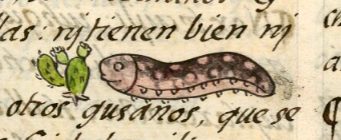
This iconographic example, featuring a prickly pear worm (citlalocuilin), is included in this digital collection for the purpose of making comparisons with related hieroglyphs. The term selected for this example comes from the text near the image in the Digital Florentine Codex. There is no gloss, per se. This example shows a profile view of citlalocuilin, facing left. The worm (ocuilin) is gray on the back with white circular spots that resemble the early way of showing stars (citlalin). It also has a light pink wash over its entire body, but clearest on the belly. It has two rows of what appear to be eight or nine tiny rounded feet on each side. The contextualizing image shows that a small prickly pear cactus (nochtli or nopalli) appears near its head. The result is something like a compound hieroglyph, except that the plant is there just to explain the association of this creature; it is not part of the name.
Stephanie Wood
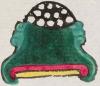
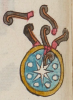
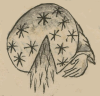
Signs for stars increasingly took on multiple points as European artistic influence increased over the sixteenth century. A Quick Search for stars will bring up many examples. But the earlier Nahuatl hieroglyphs show stars as seen here in this record. See some additional examples below.
There was also a metaphorical association between stars and worms worth noting here: "of [the animal] wounded by a shooting star, they said; 'It hath been wounded by a shooting star; it hath received a worm.'" Such an animal could not be eaten; it was feared and shunned. [See: Fr. Bernardino de Sahagún, Florentine Codex: General History of the Things of New Spain; Book 7 -- The Sun, Moon, and Stars, and the Binding of the Years, No. 14, Part VIII, eds. and transl. Arthur J. O. Anderson and Charles E. Dibble (Santa Fe and Salt Lake City: School of American Research and the University of Utah, 1961), 13.]
Stephanie Wood
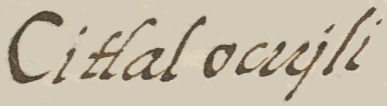
Citlalocuili
citlalocuilin
Stephanie Wood
1577
Jeff Haskett-Wood
gusanos, oruga, orugas, larva, capullo, nopales, tunas, estrella, estrellas
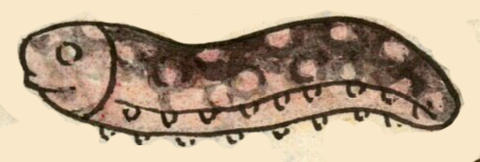
citlalocuil(in), a prickly pear worm, https://nahuatl.wired-humanities.org/content/citlalocuilin
el gusano del nopal
Stephanie Wood
Available at Digital Florentine Codex/Códice Florentino Digital, edited by Kim N. Richter and Alicia Maria Houtrouw, "Book 11: Earthly Things", fol. 105v, Getty Research Institute, 2023. https://florentinecodex.getty.edu/en/book/11/folio/105v/images/0 Accessed 16 October 2025.
Images of the digitized Florentine Codex are made available under the following Creative Commons license: CC BY-NC-ND (Attribution-NonCommercial-NoDerivs 4.0 International). For print-publication quality photos, please contact the Biblioteca Medicea Laurenziana ([email protected]). The Library of Congress has also published this manuscript, using the images of the World Digital Library copy. “The Library of Congress is unaware of any copyright or other restrictions in the World Digital Library Collection. Absent any such restrictions, these materials are free to use and reuse.”