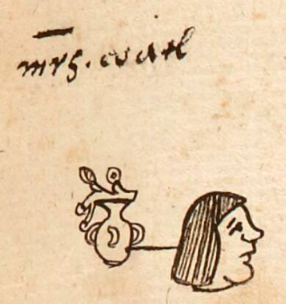
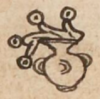
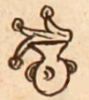
Coatl (Verg25r)
This compound Nahuatl hieroglyph is a black-line drawing of the personal name Coatl (“Serpent”) spelled out entirely phonetically and attested here as a man’s name. The elements are a pottery jug (comitl) and water (atl) coming out of the top. Is the tlacuilo intentionally disguising that the name refers to a serpent and is part of the tonalpohualli, pre-contact calendar?
Stephanie Wood
Coatl was a popular personal name, but in other manuscripts it typically comprises the drawing of a serpent. It has no numerical companion, and it may be disguised on top of this to call less attention to the name out of a worry that the clergy would object. Serious events in Tetzcoco in 1539 may have made Nahua tlacuilos more cautious when writing and painting about aspects of their faith. See Patricia Lopes Don for information about the Inquisition case against don Carlos Ometochtli, a Chichimecatecuhtli (or Chichimecateuctli) executed in late 1539, in Bonfires of Culture, 2010. Bradley Benton (The Lords of Tetzcoco, 2017, 46) also writes that the case “demonstrates that blatant disregard for Christianity had serious consequences.”
Stephanie Wood
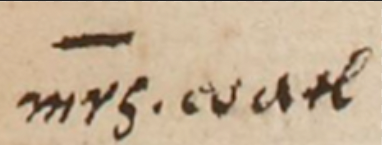
mrcs(?) coatl
Marcos Coatl
Stephanie Wood
1539
Jeff Haskett-Wood
serpientes, barro, cerámica, agua, disfraces, fonetismo, nombres de hombres, men’s names, earthenware, ceramic, ceramics, cerámicas, jug, pot, olla, jarra, jarro, vessel, vessels, vasija de cerámica, cántaro, cántaros, xoctli, xoctepi, huicolli, atlacuihuani, tecomitl, tecontontli, apilolli
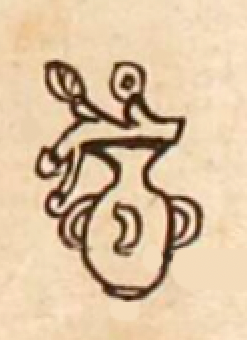
coa(tl), serpent or snake, https://nahuatl.wired-humanities.org/content/coatl
Serpiente
Stephanie Wood
Available at Codex Vergara, folio 25r, https://gallica.bnf.fr/ark:/12148/btv1b84528032/f57.item.zoom, accessed 22 February 2026. The Vergara is associated with Tepetlaoztoc, in the larger region of Tetzcoco, c. 1539–1543.
The non-commercial reuse of images from the Bibliothèque nationale de France is free as long as the user is in compliance with the legislation in force and provides the citation: “Source gallica.bnf.fr / Bibliothèque nationale de France” or “Source gallica.bnf.fr / BnF.” We would also appreciate a citation to the Visual Lexicon of Aztec Hieroglyphs, https://aztecglyphs.wired-humanities.org/.