cohuatequitl (Osu37v)
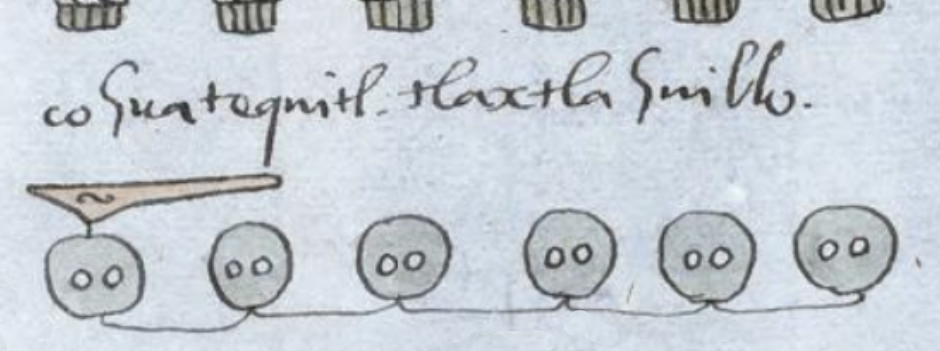
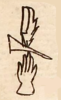
This painted simplex Nahuatl hieroglyph represents the noun for rotary draft labor, cohuatequitl. In this collection, this same item can stand for tequitl (work), not far off from coatequitl. It is actually an agricultural digging stick called a huictli. The implication is that the most common rotary draft labor was farm work. This tool appears horizontally, which is unusual, because it typically appears vertical, which was the normal posture for digging. It has a wider end with a sharp point that would facilitate the penetration of the ground. In the middle of this wider part of the tool there is a symbol shaped like a backwards and sideways letter S. The tool is a light brown or tan color, suggesting that it is made of wood. The contextualizing image shows tomín coins amounting to a peso and a half, which represented a compensation for the cohuatequitl work being discussed--not necessarily the norm.
Stephanie Wood
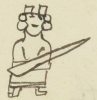
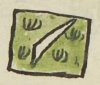
See below for additional examples of the huictli and how it can serve as a phonetic syllable (-hui or -huiz) or represent other terms for work (tequitl) or a wage laborer (Tlaquehual). It can clarify that a given field is agricultural (as in Mimil, below). In place of the S-shape, one can find a hash mark that might have a relationship with maize (see the huictli from the Codex Mendoza, f. 64 recto).
Stephanie Wood
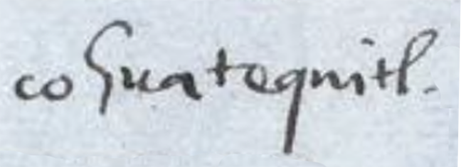
cohuatequitl.
cohuatequitl
Stephanie Wood
1551–1565
Jeff Haskett-Wood
trabajador, trabajadores, herramienta, herramientas, coa, coas, agricultura

coatequi(tl), rotary draft labor, https://nahuatl.wired-humanities.org/content/coatequitl
huic(tli), a digging stick, https://nahuatl.wired-humanities.org/content/huictli
el repartimiento (tipo trabajo)
Stephanie Wood
Library of Congress Online Catalog and the World Digital Library, Osuna Codex, or Painting of the Governor, Mayors, and Rulers of Mexico, https://www.loc.gov/resource/gdcwdl.wdl_07324/. The original is located in the Biblioteca Nacional de España.
"The Library of Congress is unaware of any copyright or other restrictions in the World Digital Library Collection. Absent any such restrictions, these materials are free to use and reuse." But please cite the Biblioteca Nacional de España and this Visual Lexicon of Aztec Hieroglyphs if you use any of these images here or refer to the content on this page, providing the URL