Cuahui (Verg33v)
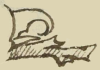
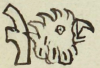
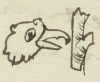
This compound Nahuatl hieroglyph is a black-line drawing of the personal name Cuahui (probably either “Tree” or “Eagle”), attested here as a man’s name. The compound shows the head of an eagle (cuauhtli) and, above that, a horizontal digging stick (huictli). The gloss shows “Cuahui” (seemingly Cuahuitl, but with the absolutive ending dropped, nothing unusual). The gloss suggests that both elements play a phonetic role, with the syllable Cua- coming from cuauhtli and -hui coming from huictli. The huictli might also be semantic, given that it is made from wood. Other Cuahui glyphs–very much like this one–appear in the Vergara on folio 34v and 36v. The latter adds an intrusive “n” at the end of Cuahui.
Stephanie Wood
In the examples of other hieroglyphs, below, note how the name Cuahuitl can be represented both by an eagle and a tree/wood, covering all bases. At least, in those cases, the glosses are not as ambiguous as this one, given that they both say Cuahuitl with the absolutive ending (-tl).
Stephanie Wood

aol. cuahui.
Alonso Cuahui
Stephanie Wood
1539
Jeff Haskett-Wood
coa, herramienta, águilas, fonetismo, nombres de hombres, men’s names
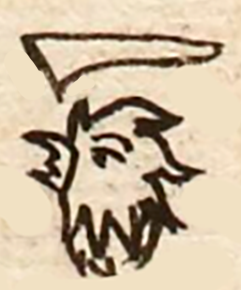
cuahui(tl), tree or wood, https://nahuatl.wired-humanities.org/content/cuahuitl
cuauh(tli), eagle, https://nahuatl.wired-humanities.org/content/cuauhtli
huic(tli), digging stick, a agricultural tool, https://nahuatl.wired-humanities.org/content/huictli
posiblemente, Árbol, o Águila
Stephanie Wood
Available at Codex Vergara, folio 33v, https://gallica.bnf.fr/ark:/12148/btv1b84528032/f74.item.zoom, accessed 1 March 2026. The Vergara is associated with Tepetlaoztoc, in the larger region of Tetzcoco, c. 1539–1543. “Source gallica.bnf.fr / BnF.” We would also appreciate a citation to the Visual Lexicon of Aztec Hieroglyphs, https://aztecglyphs.wired-humanities.org/.
Image Rights: The non-commercial reuse of images from the Bibliothèque nationale de France is free as long as the user is in compliance with the legislation in force and provides the citation: “Source gallica.bnf.fr / Bibliothèque nationale de France” or “Source gallica.bnf.fr / BnF.” We would also appreciate a citation to the Visual Lexicon of Aztec Hieroglyphs, https://aztecglyphs.wired-humanities.org/