comitl (MH484r)
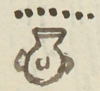
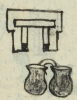
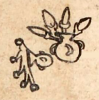
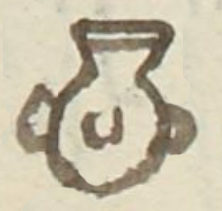
This element for an upright ceramic pot or jug (comitl) has been carved from the compound Nahuatl hieroglyph for the personal name Chicon (see below). The glyph is a black line drawing of a pottery vessel with a round body, a more narrow neck, and small handles.
Stephanie Wood
In the original compound, this glyph played a phonetic role, but here we want to show how it could also serve as a simplex logogram for a pottery jug. Mesoamerican potters were productive in making both utilitarian and decorative containers as dishes and cookware since time immemorial. The pottery griddle (comalli) for cooking tortillas was found in every home. It should also be recognized that some cookware was carved from stone (e.g., the molcaxitl, modern molcajete) or made from gourds, such as the xicalli (modern jícara), too.
Stephanie Wood
1560
Stephanie Wood
cerámica, barro, cántaros, ollas, pottery, earthenware, ceramic, ceramics, cerámicas, jug, pot, olla, jarra, jarro, vessel, vessels, vasija de cerámica, cántaro, cántaros, xoctli, xoctepi, huicolli, atlacuihuani, tecomitl, tecontontli, apilolli
comitl, ceramic pot or jub, https://nahuatl.wired-humanities.org/content/comitl
la olla
Stephanie Wood
Matrícula de Huexotzinco, folio 484r, World Digital Library, https://www.loc.gov/resource/gdcwdl.wdl_15282/?sp=47&st=image.
This manuscript is hosted by the Library of Congress and the World Digital Library; used here with the Creative Commons, “Attribution-NonCommercial-ShareAlike 3.0 License” (CC-BY-NC-SAq 3.0).