Cozan (Verg38v)
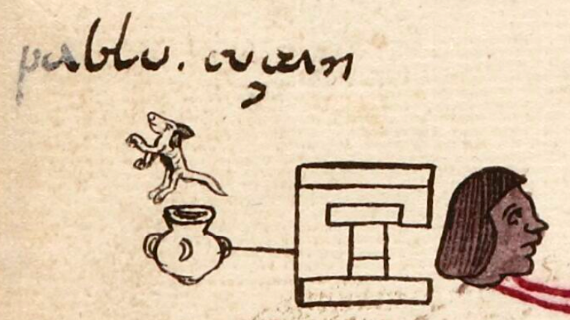
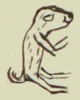
This compound Nahuatl hieroglyph is a black-line drawing of the personal name Cozan (perhaps “Lynx,” attested here as man’s name) shows a profile view of a small animal, facing left, and rising up on its hind legs. Its front left paw is raised higher than its right paw, which suggests movement. Its ears are relatively large and its ribs are showing. It may be a lynx, although it is difficult to be certain. Below the animal is a pottery jug or pot (comitl), rounded with three visible handles. The pot provides the phonetic syllable -co-, which indicates that the name starts with Co-.
Stephanie Wood
One other name Cozan appears in this digital collection (as of March 2026), and there is one Cozatli. Cozan comes from the Matrícula de Huexotzinco, revealing that the name crossed regional borders. Cozatli is in the Codex Mendoza. Because the letter -n- can intrude or inadvertently drop from a word, the terms cozatli and cozantli, which are both about small animals, seem to get confused or to confound translations.
Stephanie Wood
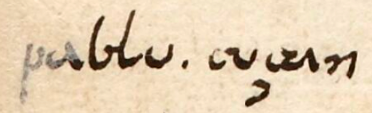
Pablo. Coçan
Pablo Cozan
Stephanie Wood
1539
Jeff Haskett-Wood
animales, linces, barro, comadrejas, hurón, hurones, fonetismo, nombres de hombres, men’s names, earthenware, ceramic, ceramics, cerámicas, jug, pot, olla, jarra, jarro, vessel, vessels, vasija de cerámica, cántaro, cántaros, xoctli, xoctepi, huicolli, atlacuihuani, tecomitl, tecontontli, apilolli
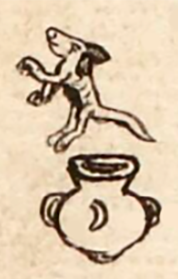
cozan(tli), a lynx or a snow leopard, https://nahuatl.wired-humanities.org/content/cozantli
coza(tli), a weasel or a ferret, https://nahuatl.wired-humanities.org/content/cozatli
posiblemente Lince, o Comadreja
Stephanie Wood
Available at Codex Vergara, folio 38v, https://gallica.bnf.fr/ark:/12148/btv1b84528032/f84.item.zoom, accessed 1 March 2026. The Vergara is associated with Tepetlaoztoc, in the larger region of Tetzcoco, c. 1539–1543. “Source gallica.bnf.fr / BnF.” We would also appreciate a citation to the Visual Lexicon of Aztec Hieroglyphs, https://aztecglyphs.wired-humanities.org/.
Image Rights: The non-commercial reuse of images from the Bibliothèque nationale de France is free as long as the user is in compliance with the legislation in force and provides the citation: “Source gallica.bnf.fr / Bibliothèque nationale de France” or “Source gallica.bnf.fr / BnF.” We would also appreciate a citation to the Visual Lexicon of Aztec Hieroglyphs, https://aztecglyphs.wired-humanities.org/