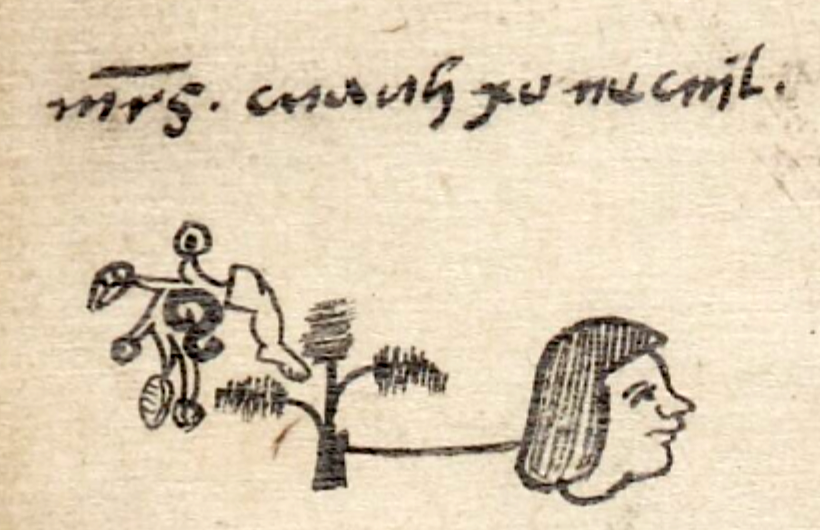
Cuauhxonecuil (Verg43v)
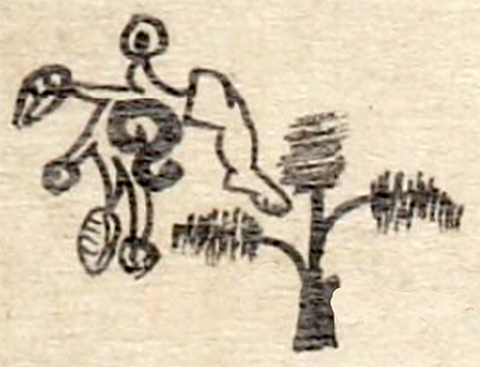
This compound Nahuatl hieroglyph is a black-line drawing of the personal name Cuauhxonecuil (perhaps “Wooden Staff Offering”), attested here as a man’s name. The compound seems to have four elements. The first, on the lower right, is the sign for amaranth (huauhtli), which provides the phonetic syllable Cuauh- (short for “wood”). Upward and to the left is a leg with a foot, providing the phonetic syllable -xo-. If it is a twisted leg, then this element covers xonecuilli, too. Moving left, there is a black worm (ocuilin) in a backward S-shape, providing for the phonetic syllable -cuil. Finally, there is a stream of water with five splashes, alternating between a droplet and a turbinate shell. The water (atl) makes more sense in the name Xonecuilatl, providing the final phonetic syllable. Perhaps this name should also end in -atl. The first names are the same, so this is probably the same man, given how the same people, in different capacities, do repeat in this manuscript.
Stephanie Wood
See our Online Nahuatl Dictionary for further information about the term xonecuilli, which has many meanings. A xonecuilli could reference a constellation, citlalxonecuilli. Also, INAH reports (8 May 2025) that xonecuilli has associations with planet Venus. See the larger discussion of xonecuilli in an article by Ian Mursell about special feasts in Mexicolore. If this example does refer to a religious offering, there could be a good reason to disguise that fact. Serious events in Tetzcoco in 1539 may have made Nahua tlacuilos more cautious when writing and painting about aspects of their faith. See Patricia Lopes Don for information about the Inquisition case against don Carlos Ometochtli, a Chichimecatecuhtli (or Chichimecateuctli) executed in late 1539, in Bonfires of Culture, 2010. Bradley Benton (The Lords of Tetzcoco, 2017, 46) also writes that the case “demonstrates that blatant disregard for Christianity had serious consequences.”
Stephanie Wood

mrs. cuauhxonecuil.
Marcos Cuauhxonecuil
Stephanie Wood
1539
Jeff Haskett-Wood
amaranto, pierna, pie, gusano, agua, bastón, religión, ofrenda, nombres de hombres, men’s names, fonetismo
xonecuil(in), a maguey worm, https://nahuatl.wired-humanities.org/content/xonecuilin
xonecuil(li), a staff offered to divine forces, something twisted (e.g., leg or foot) or curvy, or a type of cactus, https://nahuatl.wired-humanities.org/content/xonecuilli
huauh(tli), amaranth, https://nahuatl.wired-humanities.org/content/huauhtli
ocuil(in), worm, https://nahuatl.wired-humanities.org/content/ocuilin
posiblemente, Bastón de Madera para Ofrendas
Stephanie Wood
Available at Codex Vergara, folio 43v, https://gallica.bnf.fr/ark:/12148/btv1b84528032/f94.item.zoom, accessed 25 March 2026. The Vergara is associated with Tepetlaoztoc, in the larger region of Tetzcoco, c. 1539–1543. “Source gallica.bnf.fr / BnF.” We would also appreciate a citation to the Visual Lexicon of Aztec Hieroglyphs, https://aztecglyphs.wired-humanities.org/.
Image Rights: The non-commercial reuse of images from the Bibliothèque nationale de France is free as long as the user is in compliance with the legislation in force and provides the citation: “Source gallica.bnf.fr / Bibliothèque nationale de France” or “Source gallica.bnf.fr / BnF.” We would also appreciate a citation to the Visual Lexicon of Aztec Hieroglyphs, https://aztecglyphs.wired-humanities.org/