eyi ipan medio tomines (Osu13r)
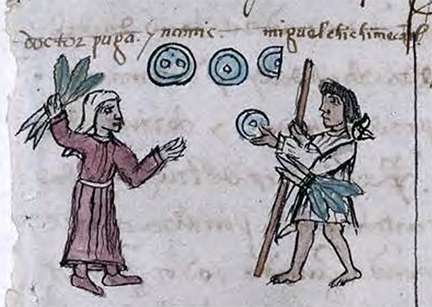
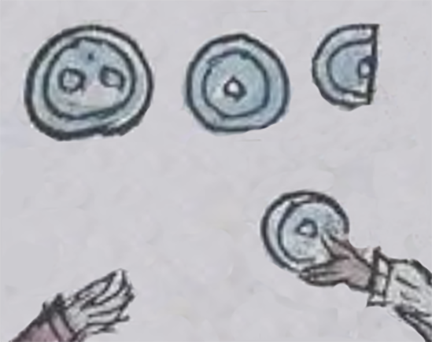
This painted example of iconography features a colonial coin called a tomin (a loanword meaning an eighth of a peso, or what Spaniards also called a real). It is a blue circle with a closely concentric circle all painted blue. Actually, there are several coins in a group, and each one has dots that signify its value. The horizontal row at the top of the image is the total, 3.5 tomines. These coins include one that is worth two tomines, another with the value of one tomin, and there is a half-tomin. The loanword medio came into Nahuatl from Spanish; sometimes it was spelled melio. The additional coin being held by a hand is an indication that this money was paid to someone.
Stephanie Wood
There is no gloss that clarifies that these are indeed tomines, but comparisons with other glossed hieroglyphs of coins make it clear. From those other examples, it is clear that the coins with two dots and one dot could have been combined into one coin with three dots. The “ipan” (plus) in the count of the coins is arbitrary; it might also have been ihuan (and). One tomin, an eighth of a peso, might be what a Nahua person would earn for a day’s labor, so humble Nahuas were accustomed to dealing in tomines, whereas elite Nahuas and Spaniards were more accustomed to pesos. The contextualizing image shows a Spanish woman on the left of a Nahua man named Miguel Chichimecatl. He is holding a staff of office, a likely indication that he was a town council officer. He holds out one of the coins in question to the Spanish woman. She is identified as the wife of Dr. Puga, the judge on the high court and the man who was coercing tribute payments in kind from various Nahua pueblos. She also seems to be threatening the Nahua man, demanding that he give her money. Elsewhere in this manuscript, Miguel Chichimecatl appears to have been beaten and probably killed by this spouse of Doctor Puga. See the other namictli example, below. This manuscript is full of complaints about abuses committed by the judges, some of which got redressed in a decision by the viceroy.
Stephanie Wood
1551–1565
Jeff Haskett-Wood
número, números, dinero, moneda, monedas, colonialismo, protesta, protestas, resistencia
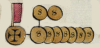
nahui, four, https://nahuatl.wired-humanities.org/content/nahui
ipan, plus or additional, https://nahuatl.wired-humanities.org/content/ipan
medio, half, a loanword from Spanish, https://nahuatl.wired-humanities.org/content/medio
cuatro tomines y medio
Stephanie Wood
Library of Congress Online Catalog and the World Digital Library, Osuna Codex, or Painting of the Governor, Mayors, and Rulers of Mexico, https://www.loc.gov/resource/gdcwdl.wdl_07324/. The original is located in the Biblioteca Nacional de España.
"The Library of Congress is unaware of any copyright or other restrictions in the World Digital Library Collection. Absent any such restrictions, these materials are free to use and reuse." But please cite the Biblioteca Nacional de España and this Visual Lexicon of Aztec Hieroglyphs if you use any of these images here or refer to the content on this page, providing the URL.