namictli (Osu12v)
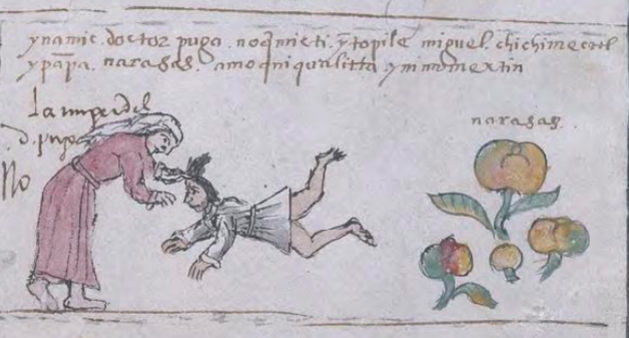
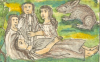
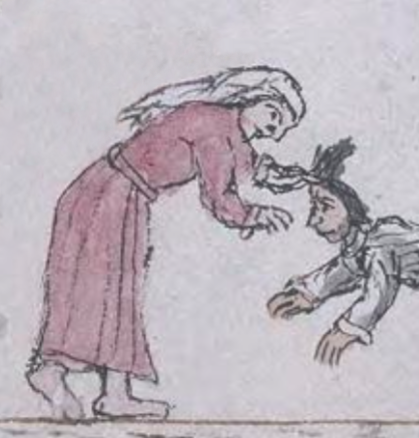
This painting from the Codex Osuna, folio 12 verso (or Image 27), shows the wife of Dr. Puga, who was a local Spaniard and a magistrate for the colony. We are calling this iconography, because it is not necessarily a glyph. According to the Nahuatl text, she beat or killed (the text uses the verb, mictia) the Nahua topile (constable of the Indigenous community) who appears in the contextualizing image. There, he is horizontal, stomach down, which is an abnormal position for a man. The trigger for the act had something to do with her dislike of some oranges that appear in the contextualizing image. The name of the topile was Miguel Chichimecatl, a man who was regularly mistreated, as shown elsewhere in this codex. In this scene the Spaniard's wife is grabbing Chichimecatl by the hair, similar to a Nahua's capture of enemies in battle. His hair is brown, and he wears a white, long-sleeved shirt. She is shown in profile, facing right, and wearing a long, red, belted gown and a long white cloth (like a scarf) covering her hair.
Stephanie Wood
Esta pintura del reverso del folio 12 (imagen 27) del Códice Osuna nos muestra a la esposa del doctor Puga, un juez español residente en Nueva España. Lo consideramos como un ejemplo iconográfico ya que no es necesariamente un glifo. Según el texto náhuatl, la mujer apaleó o mató (mictia) al topile (alguacil, según Alonso de Molina: véase https://nahuatl.wired-humanities.org/content/topile) nahua que aparece en la imagen contextual en posición horizontal y bocabajo: una posición inusual para un hombre. El desencadenante del drama tuvo algo que ver con el enojo de la española respecto a unas naranjas que aparecen en la imagen contextual. El topile se llamaba Miguel Chichimecatl y sufría de constantes maltratos, como se ve en otras secciones del códice. En esta escena la mujer lo está aferrando de los cabellos, de manera similar a como se capturaba a los enemigos en una batalla, y aparece de perfil, mirando hacia la derecha y vestida con una túnica roja con un cinturón, además de un trozo de tela larga y blanca (como un pañuelo) que le cubre los cabellos; estos son de color marrón en el caso de Chichimecatl, quien viste una camisa blanca de mangas largas.

1551–1565
Jeff Haskett-Wood
crimen, violencia, aportamiento, mujeres, españoles, frutas, conflictos, topiles, mal trato, castigo, cuamomotzoa, cuamotzollalia, cuazacamoa, tzonhuilana, tirar del pelo, insultar
namic(tli), spouse, https://nahuatl.wired-humanities.org/content/namictli
mictia, to kill or to beat someone, https://nahuatl.wired-humanities.org/content/mictia
topile, constable, https://nahuatl.wired-humanities.org/content/topile
la mujer casada
Stephanie Wood
Library of Congress Online Catalog and the World Digital Library, Osuna Codex, or Painting of the Governor, Mayors, and Rulers of Mexico (Pintura del Gobernador, Alcaldes y Regidores de México), https://www.loc.gov/resource/gdcwdl.wdl_07324/. The original is located in the Biblioteca Nacional de España.
"The Library of Congress is unaware of any copyright or other restrictions in the World Digital Library Collection. Absent any such restrictions, these materials are free to use and reuse." But please cite the Biblioteca Nacional de España and this Visual Lexicon of Aztec Hieroglyphs if you use any of these images here or refer to the content on this page, providing the URL.