eyi tomin (Osu16r)
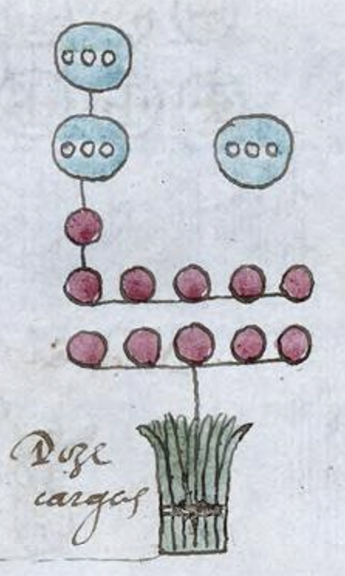
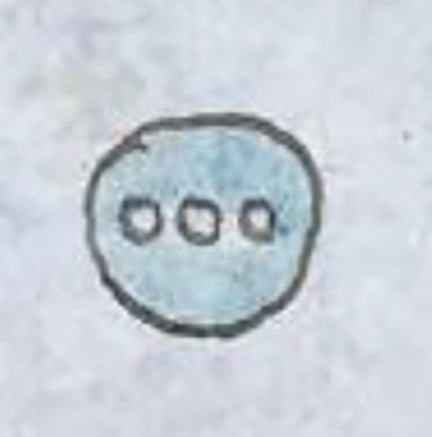
This painted simplex Nahuatl hieroglyph for a coin (tomin) shows a blue coin (likely silver) with three white dots. If it had one dot, it would be worth one tomin, but with three dots it represents three tomines, which is the equivalent of three reales (eighths of a Spanish peso). Without a Nahuatl-language gloss, we cannot be sure that this would be written eyi tomines; perhaps it should be etomin (like we see in etecpantli or nauhtomin). Not having a gloss to ensure that tomin is the vocabulary term of focus, other material in this collection that includes coins does make this assessment reliable. The contextualizing image shows three of these three-tomin hieroglyphs. The eleven red circles have lines connecting them to two of the three-real coins. The lines imply a multiplier effect, or, eleven times six, for a subtotal of 66 tomines. But then, off by itself is one more blue coin worth three tomines. Because there is no connecting line to this latter coin, it would just be added to the subtotal, bringing the grand total to 69 tomines. Humble Nahuas more often dealt in tomines than in pesos, given that a day’s labor on a neighboring estate might be one tomin. But a elite Nahuas and Spaniards would be tempted to figure the total in pesos, dividing by 8, resulting in 8 pesos and 5 reales.
Stephanie Wood
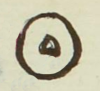
While there is no Nahuatl-language gloss to explain that tomin is the vocabulary term of focus, other material in this collection that includes coins makes this assessment reliable. The contextualizing image shows that twelve loads of “yerva” (hierba, grass, which is also called mazatlacualli, “deer” food, i.e. horse fodder, elsewhere in this manuscript) had this value, nearly 9 pesos. This was expected as part of the tribute in kind that the town would have to provide per day. Not shown here, the larger context includes a large number of peso coins in the top, center and left. The peso coins are also blue, but the peso of full value has a cross on it. The pesos are an indication of the value of this tribute per month or per year. At the bottom of the contextual image, a fully-clothed Spaniard named Doctor Villalobos sits in a curule chair, wears a sword, carries a staff of office, and emits a speech scroll from his mouth. These are all signs of his ethnicity and his status. Interestingly, the tlacuilo who painted this scene gives Dr. Bravo, a judge of the high court (Audiencia) of New Spain, a hieroglyphic name that is a challenge to decipher. See a discussion of this challenge on the Tlacuilolli blog.
Stephanie Wood
1551–1565
Jeff Haskett-Wood
plata, tres reales, moneda, monedas, dinero, tributo, tributos, forraje, writing=simplex logogram
tom(in), a coin or money, https://nahuatl.wired-humanities.org/content/tomin
eyi, three, https://nahuatl.wired-humanities.org/content/eyi
Library of Congress Online Catalog and the World Digital Library, Osuna Codex, or Painting of the Governor, Mayors, and Rulers of Mexico, https://www.loc.gov/resource/gdcwdl.wdl_07324/. The original is located in the Biblioteca Nacional de España.
"The Library of Congress is unaware of any copyright or other restrictions in the World Digital Library Collection. Absent any such restrictions, these materials are free to use and reuse." But please cite the Biblioteca Nacional de España and this Visual Lexicon of Aztec Hieroglyphs if you use any of these images here or refer to the content on this page, providing the URL.