Gallego (Osu27r)
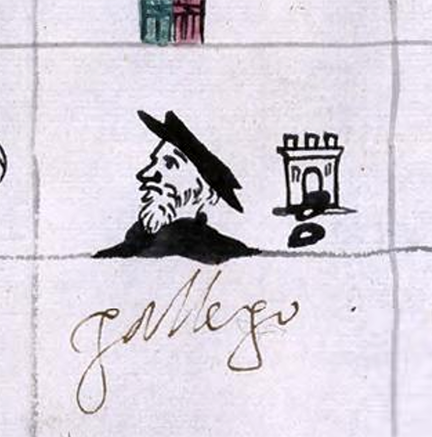
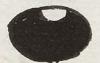
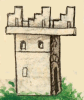
This black-and-white line drawing features the compound Nahuatl hieroglyph for the Spanish surname, Gallego. There are two elements. The first in a house or building (calli) with a curving arch to the entryway, two small windows and crenelation on the roof. At the entryway and below that are two black beans (etl). Both elements supply phonetic syllables. The -cal- provides the start to the name, Ca- or Cal- (i.e., Gal-, if one “l” was heard in the pronunciation of Gallego in the sixteenth century). The beans supply the -e- syllable that precedes the final -go (and the latter is not covered visually).
Stephanie Wood
This could be called a visual loanword along the lines of those elucidated by Juan José Batalla Rosado (2018), given that it stands for a Spanish surname. In that same study, Batalla discusses the rounded arch as a European introduction.
Stephanie Wood
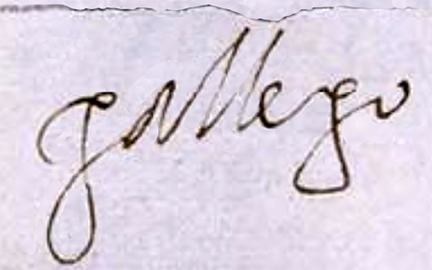
gallego
Gallego
Stephanie Wood
1551–1565
Jeff Haskett-Wood
frijol, frijoles, casa, casas, edificio, edificios, fonetismo
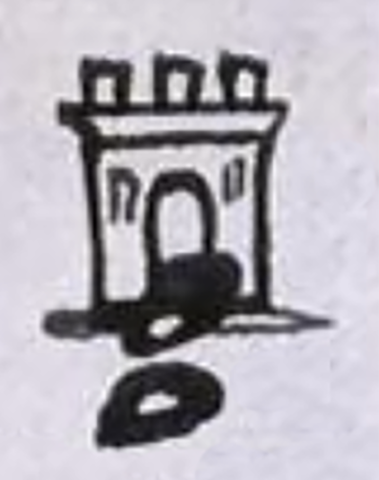
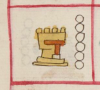
cal(lli), house, https://nahuatl.wired-humanities.org/content/calli
e(tl), beans, https://nahuatl.wired-humanities.org/content/etl
Library of Congress Online Catalog and the World Digital Library, Osuna Codex, or Painting of the Governor, Mayors, and Rulers of Mexico, https://www.loc.gov/resource/gdcwdl.wdl_07324/. The original is located in the Biblioteca Nacional de España.
"The Library of Congress is unaware of any copyright or other restrictions in the World Digital Library Collection. Absent any such restrictions, these materials are free to use and reuse." But please cite the Biblioteca Nacional de España and this Visual Lexicon of Aztec Hieroglyphs if you use any of these images here or refer to the content on this page, providing the URL.