Huitzilecatl (Verg34r)
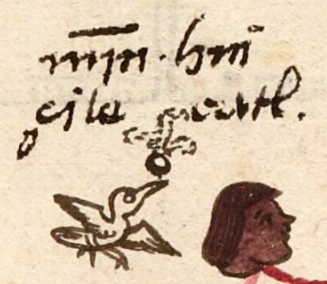
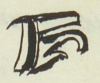
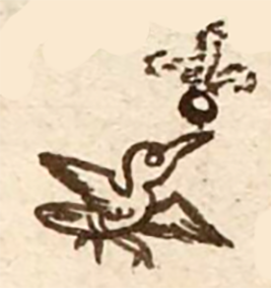
This compound Nahuatl hieroglyph is a black-line drawing of the personal name Huitzilecatl (“Hummingbird-Wind”), attested here as pertaining to a man. The elements of the compound include a hummingbird (huitzilin) and, just above its beak, a bean (etl), which provides the -e- syllable, a phonetic indicator that the final part of the name (-ecatl) starts with that vowel. Above the bean are three swirling volute shapes made of dots. The dots may represent dust or sand that helps make air (ecatl) movement or wind (ehecatl) visible.
Stephanie Wood
Another Huitzilecatl compound hieroglyph appears in the Matrícula de Huexotzinco (see below). That one includes the wind-blowing device of the divine force of Ehecatl, whereas this one has its focus on the swirling wind and a bean. This one is more subtle visually when it comes to expressing Nahua ancient beliefs about the wind. A Quick Search for Ehecatl will reveal a variety of these blowing devices, from large beaks to something more elaborate. Was this tlacuilo trying to disguise that this name was about a sacred force? Serious events in Tetzcoco in 1539 may have made tlacuilos more cautious when writing and painting about aspects of their faith. See Patricia Lopes Don for information about the Inquisition case against don Carlos Ometochtli, a Chichimecatecuhtli (or Chichimecateuctli) executed in late 1539, in Bonfires of Culture, 2010. Bradley Benton (The Lords of Tetzcoco, 2017, 46) also writes that the case “demonstrates that blatant disregard for Christianity had serious consequences.”
Stephanie Wood
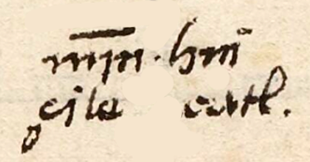
mīn. huiçilecatl.
Martín Huitzilecatl
Stephanie Wood
1539
Jeff Haskett-Wood
colibríes, pájaros, aire, aliento, soplar, soplado, fonetismo, nombres de hombres, men’s names
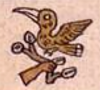
huitzil(in), hummingbird, https://nahuatl.wired-humanities.org/content/huitzilin
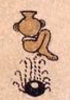
eheca(tl), wind, or the divine force of wind, https://nahuatl.wired-humanities.org/content/ehecatl
eca(tl), air, breath, https://nahuatl.wired-humanities.org/content/ecatl
Colibrí-Viento
Stephanie Wood
Available at Codex Vergara, folio 34r, https://gallica.bnf.fr/ark:/12148/btv1b84528032/f75.item.zoom, accessed 1 March 2026 The Vergara is associated with Tepetlaoztoc, in the larger region of Tetzcoco, c. 1539–1543. “Source gallica.bnf.fr / BnF.” We would also appreciate a citation to the Visual Lexicon of Aztec Hieroglyphs, https://aztecglyphs.wired-humanities.org/.
Image Rights: The non-commercial reuse of images from the Bibliothèque nationale de France is free as long as the user is in compliance with the legislation in force and provides the citation: “Source gallica.bnf.fr / Bibliothèque nationale de France” or “Source gallica.bnf.fr / BnF.” We would also appreciate a citation to the Visual Lexicon of Aztec Hieroglyphs, https://aztecglyphs.wired-humanities.org/