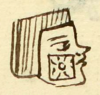
ilhuitl (TK218r)
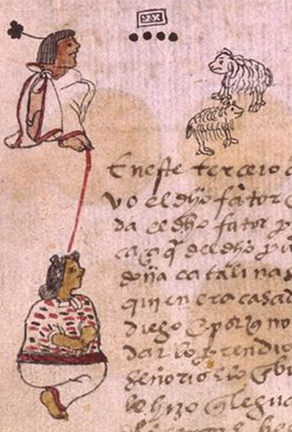
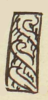
This black-line drawing of the simplex Nahuatl hieroglyph represents the word for day (ilhuitl). There is no gloss in Nahuatl, but the Spanish word for day is found in the gloss. The hieroglyph appears in a horizontal rectangle that may represent a flag, intending in this case tecpantli (twenty). The context shows a notation of four dots underneath the glyph, serving as a multiplier, and the Spanish text refers to eighty days. Thus, 4 x 20 would be eighty. But the flag is not obvious. Being inside a rectangular border is also something witnessed as an indicator of time, such as the way a year (xihuitl) is also boxed as a rule. Inside the rectangle are two shapes. The one on the left is too obscure to make out, but the one on the right looks much like the sign for tonalli, a quincunx shape. The reference to eighty days is part of the narrative about how the local Spanish authority made an unreasonable demand of the local Nahua leader, and when he refused he was dragged off to the Spaniard’s ranch, where he had to guard the sheep for eighty days as punishment.
Stephanie Wood
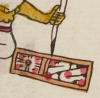
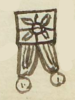
A couple of the hieroglyphs for ilhuitl can be found in this digital collection. The act of writing (tlacuiloliztli) contains a glyph for ilhuitl, a rectangle with two squares, one with a quincunx/sun/flower and one with speech scrolls that indicate ilhuia, to speak, a near homonym for ilhuitl. The ilhuitl sign with these two parts is also a metaphor for the tonalpohualli, “count of the days” calendar. Tonalli also can refer to a day, and the Atonal glyph has one of these squares with the quincunx that comprise half of the ilhuitl glyph. The name glyph, Texauhqui, also seems to have it. Various huipiles (women’s blouses) seem to have a sun sign on the patch at the base of the V-neck, such as the one seen on the chile vendor (chilnamacac) See below.
Side Note: The folio numbers are not always clear in the copy published online by the British Museum. Marc Thouvenot gives this page the number K16_A in his TLACHIA digital collection, https://tlachia.iib.unam.mx/tepetlaoztoc/K16A.
Stephanie Wood
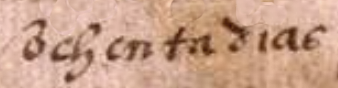
ochenta dias
ochenta días
Stephanie Wood
c. 1556
Jeff Haskett-Wood
días, calendario, calendarios, tiempo

ilhui(tl), a day, https://nahuatl.wired-humanities.org/content/ilhuitl
tonal(li), sun, a day, solar heat, https://nahuatl.wired-humanities.org/content/tonalli
el día
Stephanie Wood
The Codex Kingsborough, also known as the Códice de Tepetlaoztoc, and the Memorial de los indios de Tepetlaoztoc, is not on display. It was transferred from the British Library and is now held by the British Museum. It is shared on line at: https://www.britishmuseum.org/collection/object/E_Am2006-Drg-13964
©The Trustees of the British Museum. Shared under a Creative Commons Attribution-Non-Commercial-ShareAlike 4.0 International (CC BY-NC-SA 4.0) license. Please also cite the <em>Visual Lexicon of Aztec Hieroglyphsem>, ed. Stephanie Wood (Eugene, Ore.: Wired Humanities Projects, 2020-present) and this URL.