Itzcuintli (MH519v)
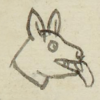
This black-line drawing of a simplex Nahuatl hieroglyph for the personal name Itzcuin shows the head of a dog (itzcuintli) in profile, looking toward the viewer's right. His one visible eye is open, his ears are standing up, and his mouth is open enough to reveal teeth. His nose curls a little bit. His coat does not have coloring or texturing, it is just left neutral.
Stephanie Wood
Este dibujo de trazos negros del jeroglífico simple náhuatl para el nombre propio Itzcuin nos muestra la cabeza de un perro (itzcuintli) de perfil que mira hacia la derecha del espectador, con orejas paradas, su único ojo visible abierto y la boca entreabierta en la que se aprecian los colmillos. Su nariz se curva ligeramente hacia arriba y su pelaje se infiere en el dibujo, al no estar plasmado con colores o texturas.
Itzcuintli is a day sign in the tonalpohualli, the 260-day divinatory calendar, and calendrics played a significant role in Nahuas' religious views of the cosmos. Originally, this calendrical name would be accompanied by a number from 1 to 13, but the use of numbers was either fading away or being suppressed. Colonial clergy were working to stop Nahuas from consulting the ancestral calendar for naming their children. Another probable issue from the point of view of the clergy was that an animal spirit (nahualli) could take the shape of a dog. This was a surviving belief in stories collected by twentieth-century ethnography, such as Los cuentos en náhuatl de Doña Luz Jiménez, recop. Fernando Horcasitas and Sarah O. de Ford (México, UNAM, 1979), 32–33.
Stephanie Wood
El (itzcuintli) era un signo de día en el calendario religioso-adivinatorio de 260 días llamado tonalpohualli; recuérdese que los calendarios tenían un papel fundamental en la religión y cosmovisión de los nahuas. Lo normal era que el nombre calendárico se combinase con un número del uno al trece, pero esta costumbre ya estaba desapareciendo o las autoridades la reprimían al momento de la confección de la Matrícula: el clero novohispano buscaba impedir que los nahuas consultasen su calendario ancestral para elegir los nombres de sus hijos. Es probable que, desde el punto de vista de los curas, el hecho de que un espíritu animal (nahualli) pudiese asumir la forma de un perro representaba un problema adicional. La creencia en los nahualli canes perduró hasta aparecer en los cuentos recogidos por los etnógrafos del siglo XX, tales como los recopilados por Fernando Horcasitas and Sarah O. de Ford en Los cuentos en náhuatl de Doña Luz Jiménez (México: UNAM, 1979, pp. 32–33).

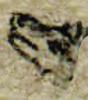
aol ytzcui~
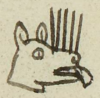
Alonso Itzcuintli
Stephanie Wood
1560
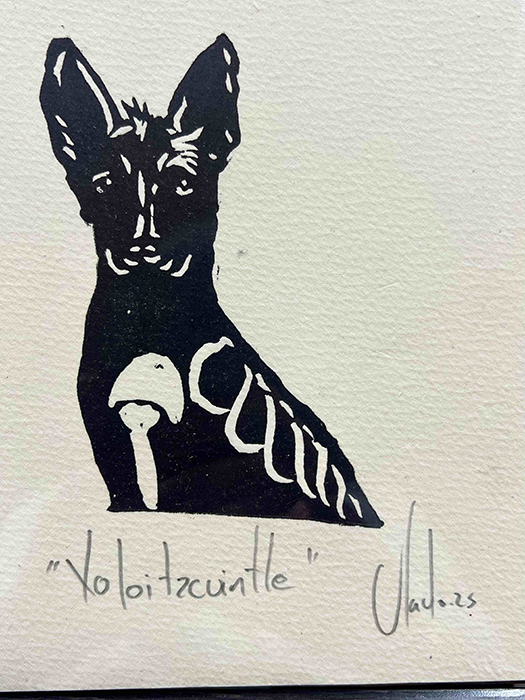
This print of “Xocoitzcuintle” (2025) is an example of Mexican artists’ continuing interest in Indigenous Mexican dogs. Armadillo Gráfico print workshop, Jalatlaco, Oaxaca. Photograph by Stephanie Wood, 23 January 2026.
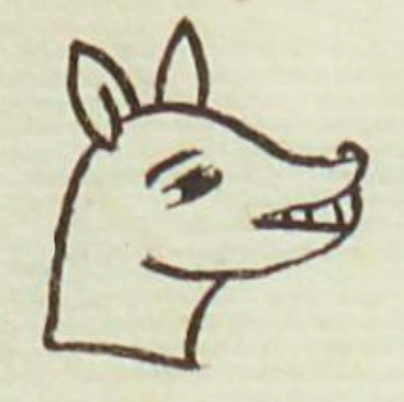
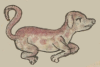
itzcuin(tli), dog, https://nahuatl.wired-humanities.org/content/itzcuintli
This manuscript is hosted by the Library of Congress and the World Digital Library; used here with the Creative Commons, “Attribution-NonCommercial-ShareAlike 3.0 License” (CC-BY-NC-SAq 3.0).