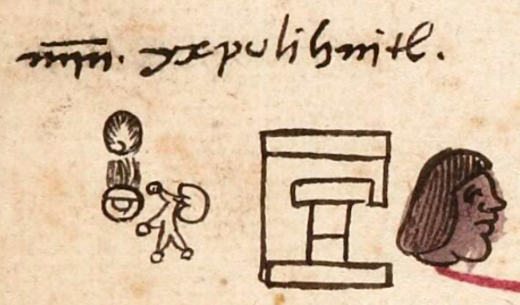
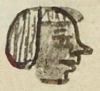
Ixpolihuitl (Verg26v)
This compound Nahuatl hieroglyph is a black-line drawing of the personal name or social status, Ixpolihuitl (“Disappeared” or “Missing”), attested here as a man’s name. The glyph includes an eye (ixtli), which is a phonetic indicator that the name or status begins with Ix-. Above the eye is a down feather (ihuitl), which is the phonetic indicator for the end of the name. The other elements appear to be a bundle of hair (tzontli?), which does not appear to be relevant to the name, and someone drinking water (coni? tlai?), which likewise seems irrelevant.
Stephanie Wood
Further analysis of the elements of this compound seems warranted. Anastasia Kalyuta gives “Ruined” or “Disappeared” for the name or status of Ixpolihuitl. See her article, "Nomen est omen: Pre-Hispanic Nahua Naming Patterns," in Mexicolore, ed. Ian Mursell (2016), https://www.mexicolore.co.uk/aztecs/language/prehispanic-nahua-naming-pa..., visited 21 February 2026. The Matrícula de Huexotzinco has a name or status that is bleak like this one, “Ca Zan Polihuiz” (He Will Completely Perish).
Stephanie Wood
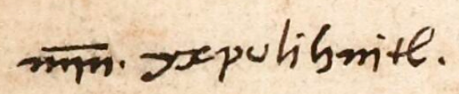
mīn. yxpolihuitl
Martín Ixpolihuitl
Stephanie Wood
1539
Jeff Haskett-Wood
desaparecer, perecer, arruinado, ojo, ojos, pluma, plumas, fonetismo, nombres de hombres, men’s names
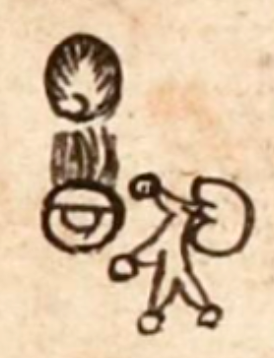
ixpolihui, to disappear, https://nahuatl.wired-humanities.org/content/ixpolihui
polihui, to disappear, to perish, to be defeated, https://nahuatl.wired-humanities.org/content/polihui
posiblemente, “El Desaparecido”
Stephanie Wood
Available at Codex Vergara, folio 26v, https://gallica.bnf.fr/ark:/12148/btv1b84528032/60.item.zoom, accessed 22 February 2026. The Vergara is associated with Tepetlaoztoc, in the larger region of Tetzcoco, c. 1539–1543.
The non-commercial reuse of images from the Bibliothèque nationale de France is free as long as the user is in compliance with the legislation in force and provides the citation: “Source gallica.bnf.fr / Bibliothèque nationale de France” or “Source gallica.bnf.fr / BnF.” We would also appreciate a citation to the Visual Lexicon of Aztec Hieroglyphs, https://aztecglyphs.wired-humanities.org/.