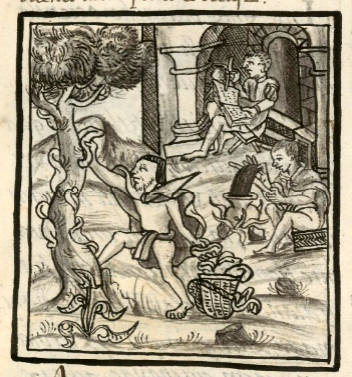
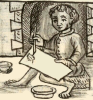
letrachihualoni (FCbk11f218v)
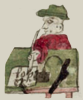
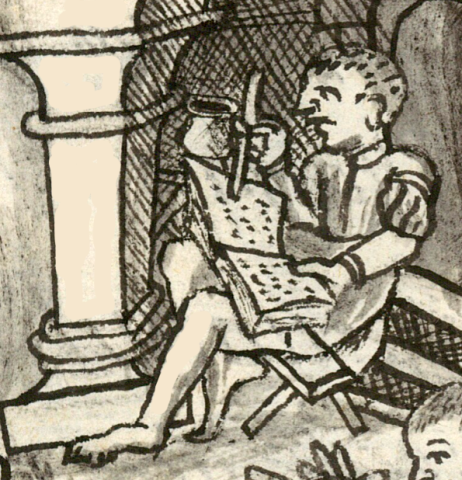
This iconographic example, featuring a man sitting in a corner writing with alphabetic letters in a bound book is an illustration of how a certain colorant could be used for painting or writing (letrachihualoni), is included in this digital collection for the purpose of making comparisons with related hieroglyphs. The term selected for this example comes from the text near the image in the Digital Florentine Codex. There is no gloss, per se. This example shows a man (probably Nahua) off in a corner, sitting on a (probably wooden) stool with legs, writing with letters (letra) in a bound book. This term is part of a paired construction that refers to painting and writing, and the inclusion of the loanword “letters” makes a conscious distinction between painting and writing that grew through European influence. Note, too, how the man is dressed, in a very European style, with early modern puffy sleeves and very short hair. His clothing is shaded, making it three-dimensional, other European influences.
Stephanie Wood
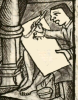
The marks on the page resemble alphabeting writing, not hieroglyphic writing, which also suggests some evolution from early forms of writing to the type of writing tlacuilos were taught in colonial schools. This digital collection has many examples of pieces of paper and books with these alphabetic markings. Rarely do any visual forms of writing show curling marks or pictorial figures. One rare one showing a human figure on a page is amoxtli (FCbk6f168v). Below is an escribano (the Spanish equivalent for tlacuilo) who is writing something that clearly includes letters, even if they do not form a whole word.
Stephanie Wood

tlacuiloloni, letra chihualoni
tlacuiloloni, letrachihualoni
Stephanie Wood
1577
Jeff Haskett-Wood
tintas, letras, escribiendo, libro, libros, papel, papeles, alfabetismo, alfabeto, palabras prestadas, hacer, pintar, pintando, escribir, escribiendo
letrachihualoni, a colorant or dye for writing, https://nahuatl.wired-humanities.org/content/letrachihualoni
tlacuiloloni, a medium for painting or writing, https://nahuatl.wired-humanities.org/content/tlacuiloloni
una tinta para escribir
Stephanie Wood
Available at Digital Florentine Codex/Códice Florentino Digital, edited by Kim N. Richter and Alicia Maria Houtrouw, "Book 11: Earthly Things", fol. 218v, Getty Research Institute, 2023. https://florentinecodex.getty.edu/en/book/11/folio/218v/images/0 Accessed 16 November 2025.
Images of the digitized Florentine Codex are made available under the following Creative Commons license: CC BY-NC-ND (Attribution-NonCommercial-NoDerivs 4.0 International). For print-publication quality photos, please contact the Biblioteca Medicea Laurenziana ([email protected]). The Library of Congress has also published this manuscript, using the images of the World Digital Library copy. “The Library of Congress is unaware of any copyright or other restrictions in the World Digital Library Collection. Absent any such restrictions, these materials are free to use and reuse.”