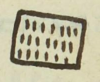
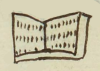
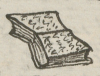
tlapallacuiloloni (FCbk22f221v)
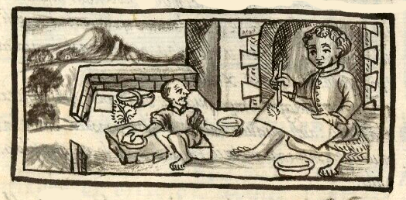
This iconographic example, featuring a man coloring a piece of paper with a brown pigment(tlapallacuiloloni), is included in this digital collection for the purpose of making comparisons with related hieroglyphs. The term selected for this example comes from the text near the image in the Digital Florentine Codex. There is no gloss, per se. This example shows what is likely a Nahua male tlacuilo seated on a low woven seat (probably an icpalli), his left hand holding a large white rectangle (probably a piece of paper or a canvas), and his right hand holding a writing or painting implement. On the paper at the tip of the tool there is a leaf drawn on the paper. This is an unusual example where the tlacuilos has created a drawing of an object, and not just put short black lines down. The implement looks a lot like the majority of writing and painting implements in the digital collection, wider at the end that touches the paper and narrower at the end that his handheld. It resembles the agricultural digging stick (huictli), but on a much smaller scale. Between the tlacuilo’s two bare feet is a bowl that holds the substance referred to as the medium for coloring (tlapallacuiloloni). Tools often end in -loni. The start of the term refers to color (often red, but not always), tlapalli. The verb to write or paint (tlacuiloa) comes next in the construction of the term of emphasis here. The man sits in front of an arched three-dimensional building, and he wears a belted, collared, cuffed, and buttoned-down tunic, both of which show European influence. The hair on his head is a big wavy, which may suggest that he is a mestizo (person of mixed Indigenous and European heritage). The contextualizing image shows that the pigment is being processed near the painter. The other man at work in the scene is handing another bowl of paint to the painter.
Stephanie Wood
The Florentine Codex is a rich source for showing tlacuilos at work. What varies in instructive ways are the writing and painting implements, the surfaces (e.g., paper, poster, canvas, bound book, etc.) on which things are written and painted, and the nature of the writing or painting (e.g., hieroglyphic, alphabetic, figurative, set in a landscape or not, etc.).
Stephanie Wood
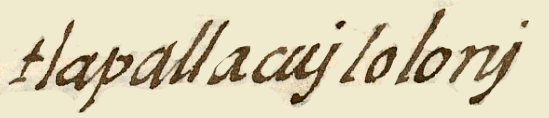
tlapallacujlolonj (or tlapallacuiloloni)
Stephanie Wood
1577
Jeff Haskett-Wood
pintando, pintado, figura, figuras, hoja, hojas, medios, papel, tela, lienzo, pintura, pastel, pasteles
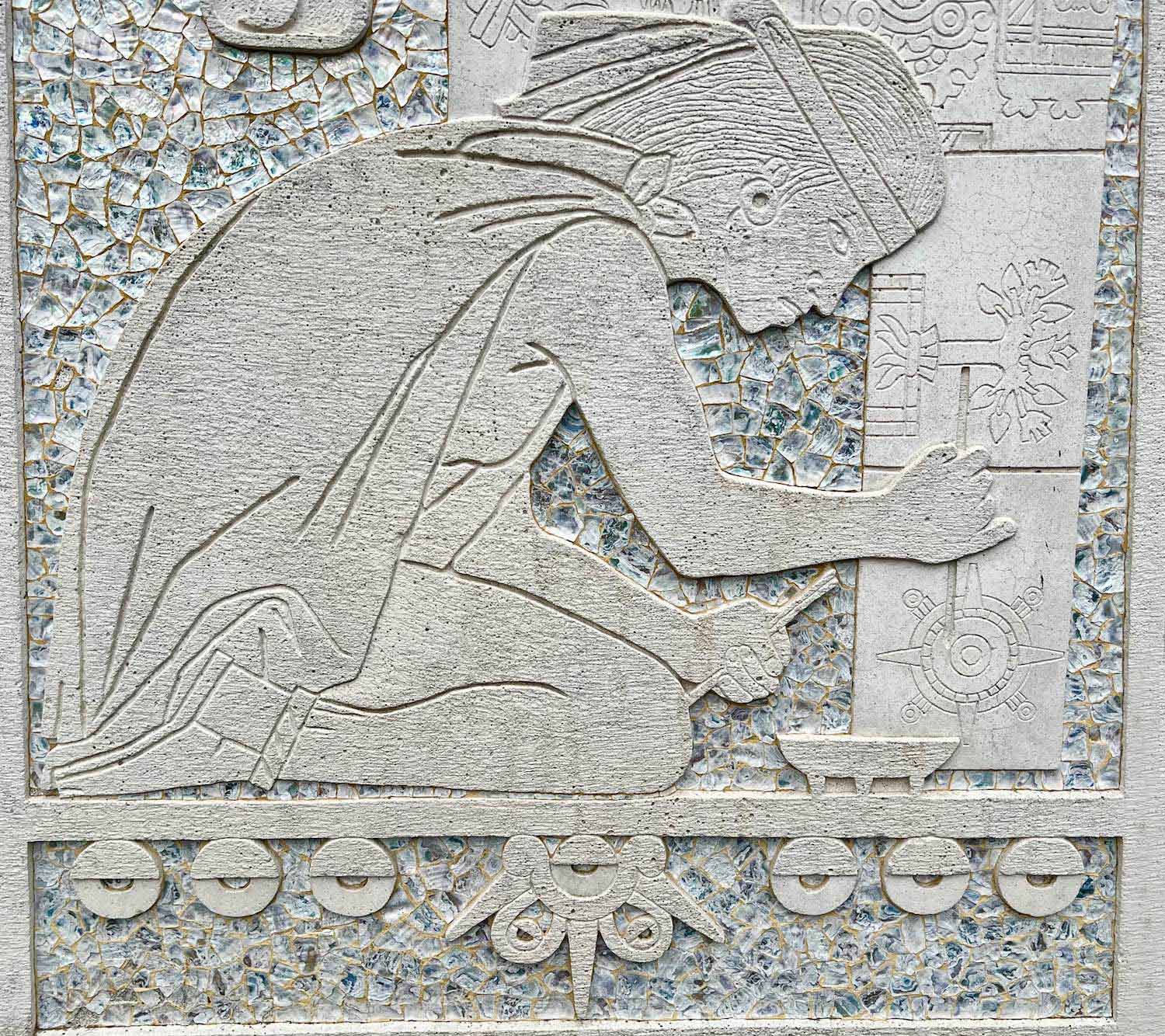
This sculpture of a tlacuilo (Indigenous writer/painter) is located in the garden of the Museo Nacional de la Acuarela “Alfredo Guati,” in Coyoacán, which generally has few works of art that feature Indigenous cultures, but an appreciation of these cultures is nevertheless evident. This tlacuilo, wearing a tilmatli, appears to be working on a hieroglyph of a sun (tonatiuh). Below the foundation where he is kneeling is a row of starry eyes. The museum signage pays homage to “los raices prehispánicas” and “sus valores estéticos y no el pensamiento mágico que ya no comprendemos.” Photograph by Stephanie Wood, 1 February 2026.
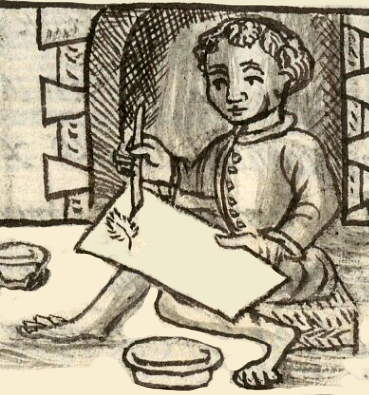
tlapallacuiloloni, a substance with which to color something, https://nahuatl.wired-humanities.org/content/tlapallacuiloloni
un medio para pintar a colores
Stephanie Wood
Available at Digital Florentine Codex/Códice Florentino Digital, edited by Kim N. Richter and Alicia Maria Houtrouw, "Book 11: Earthly Things", fol. 221v, Getty Research Institute, 2023. https://florentinecodex.getty.edu/en/book/11/folio/221v/images/0 Accessed 16 November 2025.
Images of the digitized Florentine Codex are made available under the following Creative Commons license: CC BY-NC-ND (Attribution-NonCommercial-NoDerivs 4.0 International). For print-publication quality photos, please contact the Biblioteca Medicea Laurenziana ([email protected]). The Library of Congress has also published this manuscript, using the images of the World Digital Library copy. “The Library of Congress is unaware of any copyright or other restrictions in the World Digital Library Collection. Absent any such restrictions, these materials are free to use and reuse.”