Macuilxochitl (TK207r)
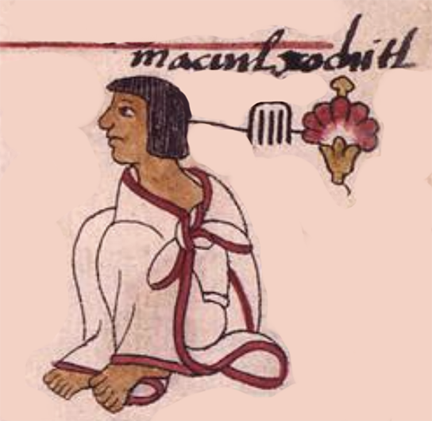
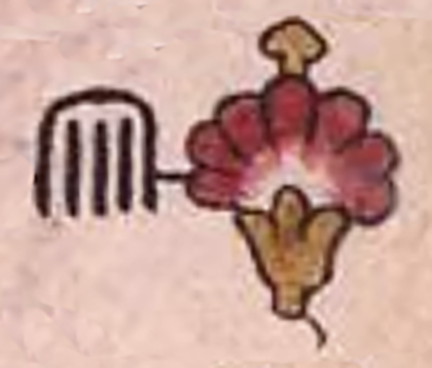
This painted simplex Nahuatl hieroglyph plus a notation represent the personal name Macuilxochitl (“Five-Flower” or “5-Flower”). This is a calendrical name, drawn from the 260-day religious divinatory calendar (tonalpohualli). It is attested as a man’s name. The simplex is a fan-like red flower with seven visible petals that fade to white at their lower ends. The flower has a tripartite-base painted brown. A single stigma, also painted brown, emerges above the top of the flower. To the left of the flower is the number five, drawn with three short vertical lines and one overarching line that adds two more ones, one each on the right and left. A line connects the number to the flower.
Stephanie Wood
This name is a classic calendrical name, retaining both the day sign and its companion number, which must be a number from 1 to 13. This is the first Macuilxochitl name to enter this database (as of May 2026), but the digital collection does have the place name Macuilxochic. See below.
Side Note: The folio numbers are not always clear in the copy published online by the British Museum. Marc Thouvenot gives this page the number K05_A in his TLACHIA digital collection, https://tlachia.iib.unam.mx/tepetlaoztoc/K05_A.
Stephanie Wood
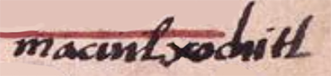
macuilxochitl
Macuilxochitl
Stephanie Wood
c. 1556
Jeff Haskett-Wood
números, flores, nombres calendáricos, nombres de hombres
macuil(li), five, https://nahuatl.wired-humanities.org/content/macuilli
xoch(itl), flower, https://nahuatl.wired-humanities.org/content/xochitl
Cinco-Flor, o 5-Flor
Stephanie Wood
The Codex Kingsborough, also known as the Códice de Tepetlaoztoc, and the Memorial de los indios de Tepetlaoztoc, is not on display. It was transferred from the British Library and is now held by the British Museum. It is shared on line at: https://www.britishmuseum.org/collection/object/E_Am2006-Drg-13964
©The Trustees of the British Museum. Shared under a Creative Commons Attribution-Non-Commercial-ShareAlike 4.0 International (CC BY-NC-SA 4.0) license. Please also cite the <em>Visual Lexicon of Aztec Hieroglyphsem>, ed. Stephanie Wood (Eugene, Ore.: Wired Humanities Projects, 2020-present) and this URL.