Mailpitoc (MH895r)
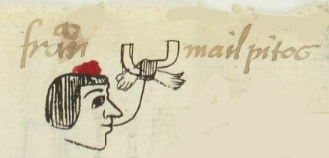
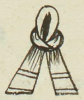
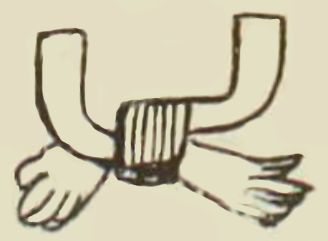
This black-line drawing of the simplex Nahuatl hieroglyph for the personal name Mailpitoc (perhaps “He Tied Someone’s Hands”) is attested here as a man’s name. The glyph shows a frontal view of two partial arms, bent at the elbows, and crossing at about the wrists. Where the wrists cross, the two arms are tied (expressing the verb, mailpia). This verb, which starts with ma-, has "hands" at its root. The -toc suffix, which makes the verb purposive and past-tense, is not shown visually.
Stephanie Wood
Este dibujo de trazos negros del jeroglífico compuesto náhuatl utilizado para designar el nombre propio Mailpitoc (quizá “Anudó las Manos de Alguien”) se registra en este caso como el nombre de un hombre. Se nos muestra una vista de frente de dos brazos incompletos, doblados por los codos, entrecruzados a nivel de las muñecas y atados entre sí en ese punto, una acción que expresa el verbo mailpia, el cual, al comenzar con ma-, tiene la raíz de “manos”. El sufijo -toc que expresa el tiempo pretérito y el propósito no se muestra de manera visual.
This appears to be a form of punishment. The question arises as to whether this is a European-influenced expression or was it a pre-contact practice? For instance, mailpia was used as part of an expression (see our Online Nahuatl Dictionary) about the hobbling of a horse. Similarly, there was an expression for tying the feet of a human or an animal, using icxi ilpia. The horse was reintroduced by Europeans; it had died out prior to contact.
Stephanie Wood
La imagen muestra lo que parece ser un tipo de castigo, pero nos preguntamos si se trata de una expresión con influencias europeas o de una práctica prehispánica. Por ejemplo, mailpia se utilizaba como parte de una expresión para referirse al trabamiento de un caballo. También había una expresión para el atado de los pies de una persona o las patas de un animal: icxi ilpia. Recuérdese que el caballo había desaparecido de América mucho antes de la llegada de los españoles y que fueron estos quienes lo reintrodujeron.
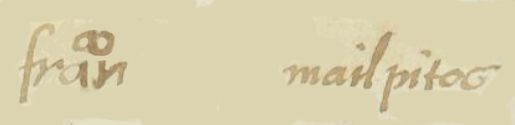
franco mailpitoc
Francisco Mailpitoc
Stephanie Wood
1560
Jeff Haskett-Wood
manos, atados, atar, nombres de hombres
mailpia, to tie someone’s hands or arms, https://nahuatl.wired-humanities.org/content/mailpia
ma(itl), hand or arm, https://nahuatl.wired-humanities.org/content/maitl
-toc (purposive action suffix, past tense), https://nahuatl.wired-humanities.org/content/toc
posiblemente, Le Ató las Manos a Alguien
Stephanie Wood
Matrícula de Huexotzinco, folio 895r, World Digital Library, https://www.loc.gov/resource/gdcwdl.wdl_15282/?sp=862&st=image.
This manuscript is hosted by the Library of Congress and the World Digital Library; used here with the Creative Commons, “Attribution-NonCommercial-ShareAlike 3.0 License” (CC-BY-NC-SAq 3.0).