maxtlatl (TK217r)
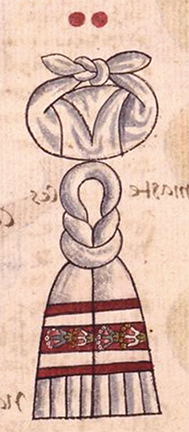
This painted simplex Nahuatl hieroglyph represents a loincloth (maxtlatl) of the type worn by elite Nahua men. The fabric has shading that gives it three-dimensionality, an artistic technique that tlacuilos learned from European teachers. The flaps in the front have red and white horizontal stripes. The widest red stripe, in the middle, has horizontal multicolored flowers. The ends of the flaps appear to be fringed with strips of white cotton cloth. The gloss calls loincloths “masteles,” which is a Hispanization and pluralization of the Nahuatl term, maxtlatl.
Stephanie Wood
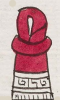
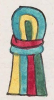
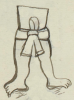
It would seem that these tribute items were likely produced in smaller numbers prior to colonization and destined to local leaders. But the Spanish-colonial level of extraction (two loads) was being protested here by the community. The question arises as to why the Spanish overlord (in this case, the encomendero, the man who had received a grant from Hernando Cortés for access to local Nahua tributes in kind and in labor) would want so many Nahua men’s loincloths. Perhaps he would sell them to elite Nahua men in the capital or use them as a trade item during spinoff invasions to the other regions that would be incorporated into “New Spain.” Macehualli (usually translated as “commoner’) men usually wore unadorned loincloths, but a few loincloths that also have some designs on them appear below.
Side Note: The folio numbers are not always clear in the copy published online by the British Museum. Marc Thouvenot gives this page the number K15_A in his TLACHIA digital collection, https://tlachia.iib.unam.mx/tepetlaoztoc/K15_A.
Stephanie Wood

masteles
maxtlatl
Stephanie Wood
c. 1556
Jeff Haskett-Wood
ropa, clothing, loincloths, knotted, textiles, tributo, tributos, colonialismo, resistencia
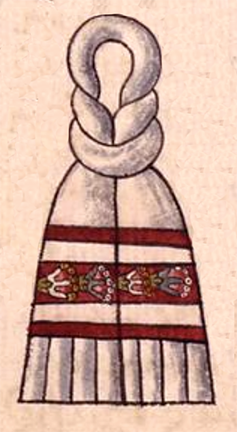
maxtla(tl), loincloth, https://nahuatl.wired-humanities.org/content/maxtlatl
el taparrabo
Stephanie Wood
The Codex Kingsborough, also known as the Códice de Tepetlaoztoc, and the Memorial de los indios de Tepetlaoztoc, is not on display. It was transferred from the British Library and is now held by the British Museum. It is shared on line at: https://www.britishmuseum.org/collection/object/E_Am2006-Drg-13964
©The Trustees of the British Museum. Shared under a Creative Commons Attribution-Non-Commercial-ShareAlike 4.0 International (CC BY-NC-SA 4.0) license. Please also cite the <em>Visual Lexicon of Aztec Hieroglyphsem>, ed. Stephanie Wood (Eugene, Ore.: Wired Humanities Projects, 2020-present) and this URL.