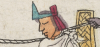
Mecahuan (MH502r)
This black-line drawing of the simplex glyph for the personal name Mecahuan ("He Who Has Ropes," attested here as a man’s name) shows a frontal view of three, upright, parallel, twisted cords or ropes (mecatl) that curve slightly to the right. The -huan ending to the name is a possessive indicator.
Stephanie Wood
Este dibujo de trazos negros del glifo simple para el nombre propio Mecahuan (“El que tiene cuerdas”) se registra en este caso como el nombre de un hombre y nos muestra tres cordeles o cuerdas (mecatl) de frente, erguidas, paralelas y retorcidas con una ligera curvatura hacia la derecha. La terminación -huan del nombre es un indicador posesivo.
As found in our Online Nahuatl Dictionary (link provided below), the mecatl could also be a whip, a noose, a unit of measure for land, and a term for a consort. .
Stephanie Wood
Como podemos ver en nuestro Online Nahuatl Dictionary (ver el enlace más abajo), un mecatl también podía ser un látigo, un nudo corredizo, una unidad de medida de terrenos y un término para denominar una consorte.
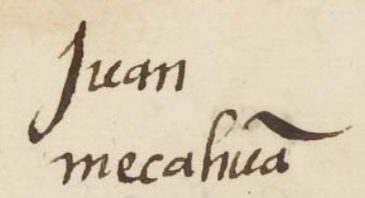
Juan
mecahuā
Juan Mecahuan
Stephanie Wood
1560
Jeff Haskett-Wood
ropes, cords, sogas, cuerdas, nooses, lazos
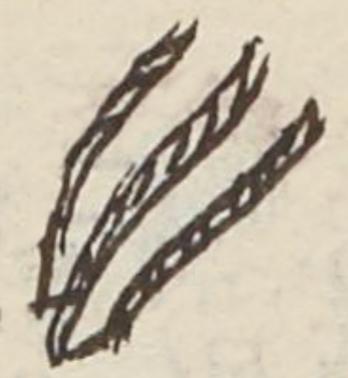
meca(tl), rope, cord, https://nahuatl.wired-humanities.org/content/mecatl
huan, plural possession, https://nahuatl.wired-humanities.org/content/huan-1
Él Que Posee Cuerdas
Stephanie Wood
Matrícula de Huexotzinco, folio 502r, World Digital Library, https://www.loc.gov/resource/gdcwdl.wdl_15282/?sp=83&st=image
This manuscript is hosted by the Library of Congress and the World Digital Library; used here with the Creative Commons, “Attribution-NonCommercial-ShareAlike 3.0 License” (CC-BY-NC-SAq 3.0).