michin (TK227r)
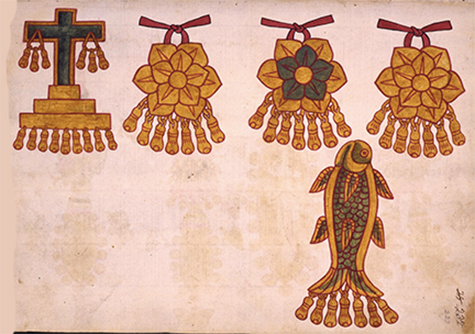
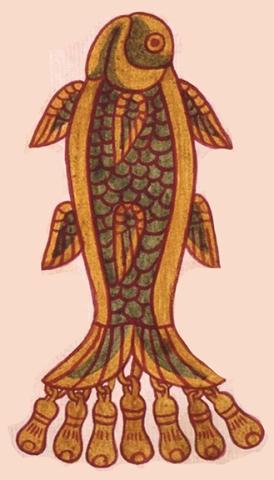
This painted example of iconography shows a piece of gold jewelry in the shape of vertical fish (michin) with its head upward. It has a bifurcated tail, and six visible fins. Its eye is open, but its mouth is closed. The fish is outlined with a gold border. Hanging from its tail are seven jingle bells suspended by red (perhaps copper) wires evenly spaced and attached to one horizontal wire that wraps around the fish just above the tail. The scales of the fish are outlined in red. The color of the scales is a dark blue-green. Perhaps precious green stone tesserae were used for the scales.
Stephanie Wood
Quite a few hieroglyphs of fish appear in this digital collection, in no small part because of the popularity of the name Mimich. They also appear in place names, such as Michhuacan (which is now modified as the name of a state in Mexico, Michoacán), Michcalco, Michapan, and Michmaloyan.
Stephanie Wood
c. 1556
Jeff Haskett-Wood
peces, pescados, comida, joya, joyas, oro, cascabel, cascabeles
mich(in), fish, https://nahuatl.wired-humanities.org/content/michin
el pez, o el pescado
Stephanie Wood
The Codex Kingsborough, also known as the Códice de Tepetlaoztoc, and the Memorial de los indios de Tepetlaoztoc, is not on display. It was transferred from the British Library and is now held by the British Museum. It is shared on line at: https://www.britishmuseum.org/collection/object/E_Am2006-Drg-13964
©The Trustees of the British Museum. Shared under a Creative Commons Attribution-Non-Commercial-ShareAlike 4.0 International (CC BY-NC-SA 4.0) license. Please also cite the <em>Visual Lexicon of Aztec Hieroglyphsem>, ed. Stephanie Wood (Eugene, Ore.: Wired Humanities Projects, 2020-present) and this URL.