Michhuacan (TR25v)
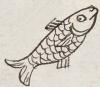
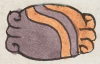
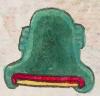
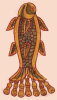
This compound glyph for the place name Michhuacan (spelled Michoacán today and meaning "Place with Fish") shows a fish (michin) on top of a mountain or hill that provides a stand-in for the -can locative suffix. The fish is horizontal and shown in profile view, facing toward the viewer's right. Its scales and fins are drawn in fine detail. Its visible eye is open, and its mouth is open slightly, too. This hill or mountain is bell-shaped and entirely green except for the white horizontal line toward the base. The slopes have curling, rocky outcroppings (as seen on the tetl, stone, glyph below). The -hua- in the place name refers to possession, and the -can says "the place where."
Stephanie Wood
There is a reason Michoacán bears this name, given the historical strength of its lakes for fishing. The freshwater whitefish (pescado blanco, in Spanish) and catfish (tilapia) are popular in recipes in Mexican cuisine still today. The popular stew, caldo michi, has a name that closely approximates the original Nahuatl term for fish (michin). In The Essential Cuisines of Mexico, Diana Kennedy (2009, 135) shares a recipe for this stew provided by a woman in Pátcuaro, Michoacan.
Stephanie Wood
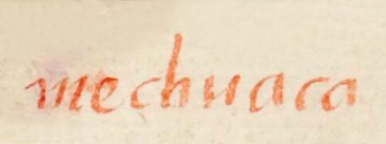
ca. 1550–1563
Jeff Haskett-Wood
fish, peces, pescado, nombres de lugares
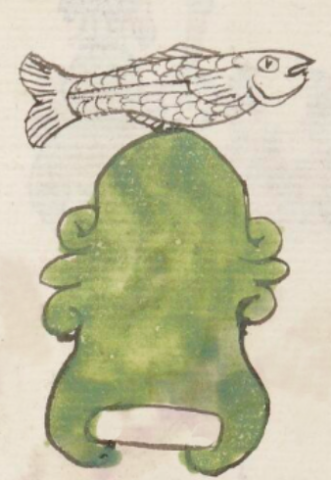
mich(in), fish, https://nahuatl.wired-humanities.org/content/michin
hua, possession, https://nahuatl.wired-humanities.org/content/hua
-can, locative suffix, https://nahuatl.wired-humanities.org/content/can-2
Telleriano-Remensis Codex, folio 25 recto, MS Mexicain 385, Gallica digital collection, https://gallica.bnf.fr/ark:/12148/btv1b8458267s/f76.item.zoom
The non-commercial reuse of images from the Bibliothèque nationale de France is free as long as the user is in compliance with the legislation in force and provides the citation: “Source gallica.bnf.fr / Bibliothèque nationale de France” or “Source gallica.bnf.fr / BnF.”