Mimich (Verg40v)
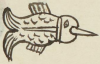
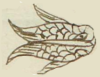
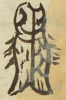
This compound Nahuatl hieroglyph is a black-line drawing of the personal name Mimich (perhaps “Little Fish”), which is attested here as a man’s name. While his wife bears the hieroglyph over her head, the gloss for her name only gives her a first name, and the “Mimich” gloss is over her husband, Diego. The compound hieroglyph has two elements: in front, a vertical fish (michin) with its head upwards, and behind, an arrow (mitl) pointing downward and to the right. The arrow provides the phonetic indicator that the name is reduplicated (starting with an extra Mi-). So, the result is a textual and visual reduplication.
Stephanie Wood
Magnus Pharao Hansen defines Mimich as "Little Fish." [See his blog from 2014, "Nahuatl Names: The Nahuatl names in the 1544 census of Morelos."] The gloss for this name includes a reduplication of the first syllable, but there is no corresponding visual reduplication in that source. Magnus Pharao Hansen defines Mimich as "Little Fish." [See his blog from 2014, "Nahuatl Names: The Nahuatl names in the 1544 census of Morelos."] There is a Mimich, for which this man may have been named, who was a Cloud Serpent paired with Xiuhnel and associated with hunting, promiscuity, and drunkenness. See The Fate of Earthly Things by Molly H. Bassett (2015). And the translators of the Primeros Memoriales say that Xiuhnel and Mimich were prominent figures in many migration stories of central Mexican cultures. See the Sullivan and Nicholson edition of the PM (1997, 135). Mimich also has a potential warrior association, as explained in our Online Nahuatl Dictionary. Mimich is a name that has lived on. Multiple examples are found in colonial testaments. See, for example, Teresa Rojas Rabiela, Elsa Leticia Rea López, and Constantino Medina Lima, Vidas y Bienes Olvidados (1999).
Stephanie Wood

diego. mimich.
Diego Mimich
Stephanie Wood
1539
Jeff Haskett-Wood
pez, peces, pescado, flecha, flechas, punta abajo, nube-serpiente, cuentos de migración, caza, promiscuidad y embriaguez

Mimich, “Little Fish,” the name of a cloud serpent (mixcoatl) in an origin story, https://nahuatl.wired-humanities.org/content/mimich
michin, fish, but could have warrior associations, https://nahuatl.wired-humanities.org/content/michin
mi(tl), arrow, https://nahuatl.wired-humanities.org/content/mitl
El Pez Pequeño
Stephanie Wood
Available at Codex Vergara, folio 40v, https://gallica.bnf.fr/ark:/12148/btv1b84528032/f88.item.zoom, accessed 10 March 2026. The Vergara is associated with Tepetlaoztoc, in the larger region of Tetzcoco, c. 1539–1543. “Source gallica.bnf.fr / BnF.” We would also appreciate a citation to the Visual Lexicon of Aztec Hieroglyphs, https://aztecglyphs.wired-humanities.org/.
Image Rights: The non-commercial reuse of images from the Bibliothèque nationale de France is free as long as the user is in compliance with the legislation in force and provides the citation: “Source gallica.bnf.fr / Bibliothèque nationale de France” or “Source gallica.bnf.fr / BnF.” We would also appreciate a citation to the Visual Lexicon of Aztec Hieroglyphs, https://aztecglyphs.wired-humanities.org/