Miquiz (Verg45r)
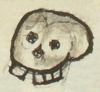
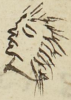
This compound Nahuatl hieroglyph is a black-line drawing of the personal name Miquiz (“Death”), attested here as a man’s name. The compound has two elements. One is the skull, which is the sign for “death” and a day name in the 260-day religious divinatory calendar (the tonalpohualli). The second element consists of five short black obsidian blades (itztli). These blades serve as a phonetic complement, assuring the reader that the name ends in -iz.
Stephanie Wood
This type of calendrical name would have originally had a numerical companion, such as Ce Miquiztli (One Death, or 1-Death). This practice was either declining or it was suppressed in reaction to the colonial clergy’s opposition to the continuing use of the tonalpohualli. The use of the phonetic complement here is an added phonetic feature that most similar names in central-area manuscripts do not have.
Stephanie Wood

franco. miquiz.
Francisco Miquiz
Stephanie Wood
1539
Jeff Haskett-Wood
muerte, cráneo, calendario, nombres de días, obsidiana, nombres de hombres, men’s names, fonetismo

miquiz(tli), death; mortality; also, a calendrical marker, https://nahuatl.wired-humanities.org/content/miquiztli
itztli, obsidian blade, https://nahuatl.wired-humanities.org/content/itztli
Muerte
Stephanie Wood
Available at Codex Vergara, folio 45r, https://gallica.bnf.fr/ark:/12148/btv1b84528032/f97.item.zoom, accessed 25 March 2026. The Vergara is associated with Tepetlaoztoc, in the larger region of Tetzcoco, c. 1539–1543. “Source gallica.bnf.fr / BnF.” We would also appreciate a citation to the Visual Lexicon of Aztec Hieroglyphs, https://aztecglyphs.wired-humanities.org/.
Image Rights: The non-commercial reuse of images from the Bibliothèque nationale de France is free as long as the user is in compliance with the legislation in force and provides the citation: “Source gallica.bnf.fr / Bibliothèque nationale de France” or “Source gallica.bnf.fr / BnF.” We would also appreciate a citation to the Visual Lexicon of Aztec Hieroglyphs, https://aztecglyphs.wired-humanities.org/