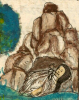
oztotl (FCbk11f244v)
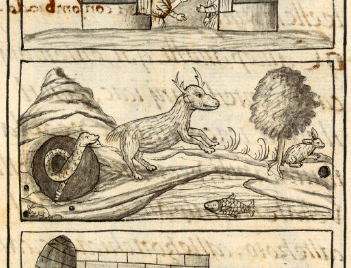
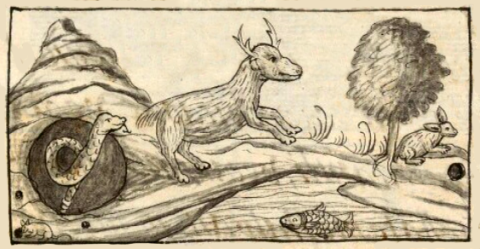
This iconographic example, featuring a black and white sketch of a cave (oztotl), is included in this digital collection for the purpose of making comparisons with related hieroglyphs. The term selected for this example comes from the text near the image in the Digital Florentine Codex. There is no gloss, per se. This example shows a wilderness landscape with a cave and several wild animals. A semi-coiled serpent emerges from the cave with its bifurcated tongue protruding. In the lower left corner a rodent goes after a nut or berry. In a nearby pond, a fish swims. A horned deer appears to move through the landscape. A rabbit seems to be on the move, too. It is near a tree that has exposed roots.
Stephanie Wood
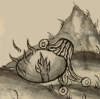
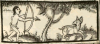
Full landscape scenes are not part of the repertoire of hieroglyphic writing as a rule. Sometimes a simplex or a compound glyph might appear in a landscape, as in the case of coztic apozonalli (FCbk11f207v). But landscape scenes tend to be included here for any details that might be comparable to glyphs. For example, the cave is featured, and each individual animal might serve as a comparable, too. Note the deer being hunted in the Chichimecatlalli (also below). The Chichimecatlalli was a place where people lived in the wilderness, which is also exhibited in the record for mictia (FCbk10f124r). The Florentine Codex illustrations were painted when many tlacuilos had moved away from hieroglyphic writing. Hence, a painting of a cave is more of a landscape than a glyph in the example of oztotl (FCbk10f121r). In contrast, the Codex Mendoza cave glyphs appear as earth monsters with their mouths open.
Stephanie Wood
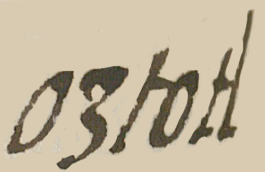
oztotl
Stephanie Wood
1577
Jeff Haskett-Wood
cuevas, caves
ozto(tl), a cave, https://nahuatl.wired-humanities.org/content/oztotl
la cueva
Stephanie Wood
Available at Digital Florentine Codex/Códice Florentino Digital, edited by Kim N. Richter and Alicia Maria Houtrouw, "Book 11: Earthly Things", fol. 244v, Getty Research Institute, 2023. https://florentinecodex.getty.edu/en/book/11/folio/244v/images/0 Accessed 16 November 2025.
Images of the digitized Florentine Codex are made available under the following Creative Commons license: CC BY-NC-ND (Attribution-NonCommercial-NoDerivs 4.0 International). For print-publication quality photos, please contact the Biblioteca Medicea Laurenziana ([email protected]). The Library of Congress has also published this manuscript, using the images of the World Digital Library copy. “The Library of Congress is unaware of any copyright or other restrictions in the World Digital Library Collection. Absent any such restrictions, these materials are free to use and reuse.”