Pinahuiz (Verg50bis-v)
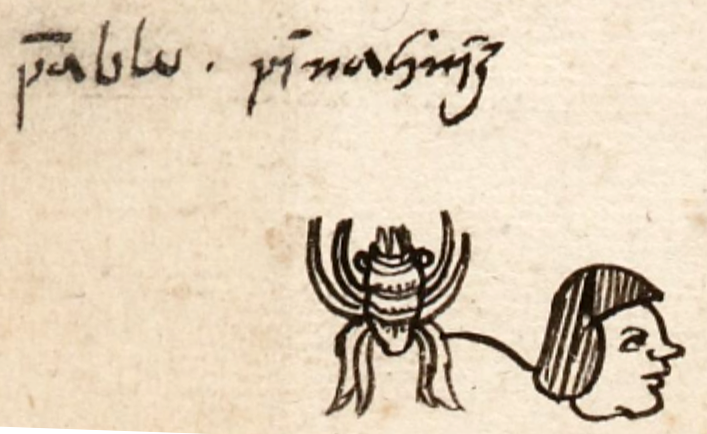
This simplex Nahuatl hieroglyph is a black-line drawing of the personal name Pinahuiz (perhaps “Omen Bug”), attested here as a man’s name. This is a bird’s eye view of the bug (possibly a beetle) or spider. It has eight legs showing, the front four going forward and the others going backward. Its back is covered with designs, such as horizontal stripes and rows of dots. It has two mandibles pointing forward on its head. Its eyes bulge slightly on the sides of the head.
Stephanie Wood
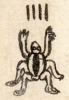
Each pinahuiztli in this digital collection differs from the others. Unlike the chapulin, the details of pinahuiztli seem not to have been very familiar to the tlacuilos. Also, this one, unlike the other two from the Vergara Codex, does not include the number 4 (nahui) as a phonetic indicator. Perhaps this tlacuilo was more certain of the details and hopeful that readers would know what bug this is without the phonetic clue.
Stephanie Wood

pāblo. pinahuiz
Pablo Pinahuiz
Stephanie Wood
1539
Jeff Haskett-Wood
escarabajos, bicho, bichos, ocho piernas, nombres de hombres, men’s names

pinahuiz(tli), a bug with omen associations, or vermin, https://nahuatl.wired-humanities.org/content/pinahuiztli
Escarabajo Que Toman por Agüero
Stephanie Wood
Available at Codex Vergara, folio 50bis-v, https://gallica.bnf.fr/ark:/12148/btv1b84528032/f110.item.zoom, accessed 25 March 2026. The Vergara is associated with Tepetlaoztoc, in the larger region of Tetzcoco, c. 1539–1543. “Source gallica.bnf.fr / BnF.” We would also appreciate a citation to the Visual Lexicon of Aztec Hieroglyphs, https://aztecglyphs.wired-humanities.org/.
Image Rights: The non-commercial reuse of images from the Bibliothèque nationale de France is free as long as the user is in compliance with the legislation in force and provides the citation: “Source gallica.bnf.fr / Bibliothèque nationale de France” or “Source gallica.bnf.fr / BnF.” We would also appreciate a citation to the Visual Lexicon of Aztec Hieroglyphs, https://aztecglyphs.wired-humanities.org/