Pinahuiz (Verg47v)
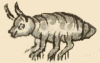
This compound Nahuatl hieroglyph is a black-line drawing of the personal name Pinahuiz (perhaps “Omen Bug,” earlier seen as Pinahuiztin, in the plural, and with a somewhat different compound hieroglyph, on folio 40 verso, and one coming on 50bis-verso). It is attested here again as a man’s name, and for a man whose first name is, once again, Pablo. The compound here has two elements, whereas it has three in the earlier example. The main element in both is the bird’s eye view of the bug that is called pinahuiztli, providing the logographic root of the name, Pinahuiz. But the bug is different as drawn in each glyph. Both bugs have a rounded back with black and white stripes. But this one has two raised “arms” with hands and four visible legs with feet. The back legs bend as though they had knees. Above the bug are four vertical, short, straight lines that represent the number four (nahui). This is a phonetic indicator that the middle of the name contains -nahui-. The other glyph has an added element of water, which this one ignores.
Stephanie Wood
Many hieroglyphs in the Codex Vergara repeat, and they are not identical in the second version. Some are quite different, whether because the tlacuilo has changed or because the tlacuilo enjoys some leeway for experimenting with variations on the same theme. The different look for the pinahuiztli from Pinahuiztin (Verg40v) to Pinahuiz (Verg47v), seems to suggest a change of tlacuilo. Changing from a plural to a singular might alternatively suggest that the gloss for this one is abbreviated more than usual. In this digital collection (as of March 2026) there are two iconographic examples of the pinahuiztli that come from the Digital Florentine Codex. See below.
Stephanie Wood

pablo. pinahuiz.
Pablo Pinahuiz
Stephanie Wood
1539
Jeff Haskett-Wood
nombres de hombres, men’s names, escarabajo, bichos, insectos, presagio, presagios, agüeros, fonetismo

pinahuiz(tli), a bug with omen associations, or vermin, https://nahuatl.wired-humanities.org/content/pinahuiztli
nahui, four, https://nahuatl.wired-humanities.org/content/nahui
Escarabajo Que Toman por Agüero
Stephanie Wood
Available at Codex Vergara, folio 47v, https://gallica.bnf.fr/ark:/12148/btv1b84528032/f102.item.zoom, accessed 25 March 2026. The Vergara is associated with Tepetlaoztoc, in the larger region of Tetzcoco, c. 1539–1543. “Source gallica.bnf.fr / BnF.” We would also appreciate a citation to the Visual Lexicon of Aztec Hieroglyphs, https://aztecglyphs.wired-humanities.org/.
Image Rights: The non-commercial reuse of images from the Bibliothèque nationale de France is free as long as the user is in compliance with the legislation in force and provides the citation: “Source gallica.bnf.fr / Bibliothèque nationale de France” or “Source gallica.bnf.fr / BnF.” We would also appreciate a citation to the Visual Lexicon of Aztec Hieroglyphs, https://aztecglyphs.wired-humanities.org/