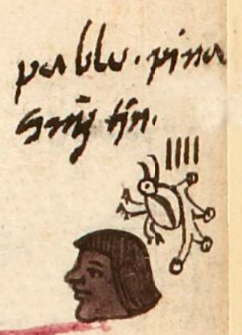
Pinahuiztin (Verg40v)
This compound Nahuatl hieroglyph is a black-line drawing of the personal name Pinahuiztin (perhaps “Omen Bugs”), which is attested here as a man’s name. The compound has three elements. One is a profile view of the bug (perhaps a beetle) that is called pinahuiztli, providing the logographic root of the name. The bug has a rounded back with black and white stripes. It has four visible legs and feet, and it has two antennae, curving over and downward. Above and to the right of the bug are four vertical, short, straight lines that represent the number four (nahui). This is a phonetic indicator that the middle of the name contains -nahui-. Perhaps it could also be a hint that the name includes a plural suffix -tin. Or perhaps the -tin is not represented visually. Finally, the third element of the compound is a stream of water (atl) with four short splashes, each one ending in a droplet or bead. The water also serves as a phonetic indicator or complement that the middle of the name has a syllable with the -a- vowel.
Stephanie Wood
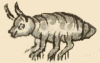
In this digital collection (as of March 2026) there are two iconographic examples of the pinahuiztli that come from the Digital Florentine Codex. See below. Otherwise, the collection has three examples coming in from the Vergara Codex.
Stephanie Wood
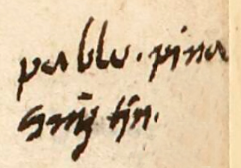
pablo. pinahuiztin.
Pablo Pinahuiztin
Stephanie Wood
1539
Jeff Haskett-Wood
nombres de hombres, men’s names, escarabajo, bichos, insectos, presagio, presagios, agüeros, fonetismo
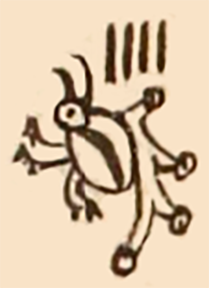
pinahuiz(tli), a bug with omen associations, or vermin, https://nahuatl.wired-humanities.org/content/pinahuiztli
nahui, four, https://nahuatl.wired-humanities.org/content/nahui
a(tl), water, https://nahuatl.wired-humanities.org/content/atl
Escarabajos Que Tienen por Agüeros
Stephanie Wood
Available at Codex Vergara, folio 40v, https://gallica.bnf.fr/ark:/12148/btv1b84528032/f88.item.zoom, accessed 14 March 2026. The Vergara is associated with Tepetlaoztoc, in the larger region of Tetzcoco, c. 1539–1543. “Source gallica.bnf.fr / BnF.” We would also appreciate a citation to the Visual Lexicon of Aztec Hieroglyphs, https://aztecglyphs.wired-humanities.org/.
Image Rights: The non-commercial reuse of images from the Bibliothèque nationale de France is free as long as the user is in compliance with the legislation in force and provides the citation: “Source gallica.bnf.fr / Bibliothèque nationale de France” or “Source gallica.bnf.fr / BnF.” We would also appreciate a citation to the Visual Lexicon of Aztec Hieroglyphs, https://aztecglyphs.wired-humanities.org/