pipiltin (TK214v)
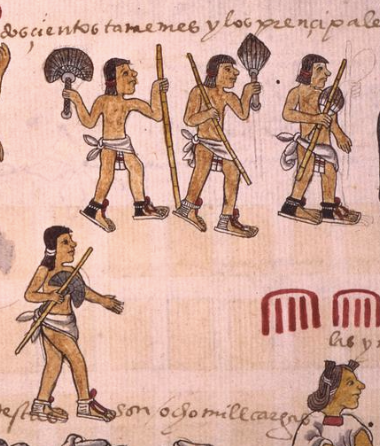
This painted example of iconography references a group of three Nahua male nobles (pipiltin) of Tepetlaoztoc, near Tetzcoco. They are standing in a three-quarter view, facing toward the viewer’s right. Their feet suggest that they are moving toward the right. Each of the three carries a staff of office. Each staff is a bamboo color and segmented. Each one also carries a hand-held dark gray or brown feather fan. All three wear loincloths with a big of a design on the front, and all wear an additional white, probably cotton cloth around the waist and tied on one hip. They wear sandals with red ties. Their haircut includes bangs, and an overall length to the shoulders but not beyond. Their skin is terracotta colored. The contextualizing image shows what may be a fourth noble.
Stephanie Wood
Pilli is the singular of pipiltin, but it also refers to a child. Both pilli and pipiltin appear in a number of hieroglyphs, but the elite were a minority. Most Nahuas in this collection held the rank of macehualli, which Europeans translated as “commoner.” The examples of pipiltin in the Mixteca region show men who are much more heavily clothed than these men from the Tetzcoco region.
Side Note: The folio numbers are not always clear in the copy published online by the British Museum. Marc Thouvenot gives this page the number K12_B in his TLACHIA digital collection, https://tlachia.iib.unam.mx/tepetlaoztoc/K12_B.
Stephanie Wood
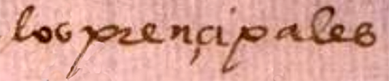
los prençipales
los principales
Stephanie Wood
c. 1556
Jeff Haskett-Wood
élite, nobleza indígena, vara de mando, jerarquía social
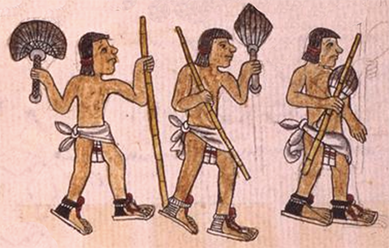
pipil(tin), male nobles, https://nahuatl.wired-humanities.org/content/pipiltin
los nobles
Stephanie Wood
The Codex Kingsborough, also known as the Códice de Tepetlaoztoc, and the Memorial de los indios de Tepetlaoztoc, is not on display. It was transferred from the British Library and is now held by the British Museum. It is shared on line at: https://www.britishmuseum.org/collection/object/E_Am2006-Drg-13964
©The Trustees of the British Museum. Shared under a Creative Commons Attribution-Non-Commercial-ShareAlike 4.0 International (CC BY-NC-SA 4.0) license. Please also cite the <em>Visual Lexicon of Aztec Hieroglyphsem>, ed. Stephanie Wood (Eugene, Ore.: Wired Humanities Projects, 2020-present) and this URL.