Quecholomi (Verg26r)
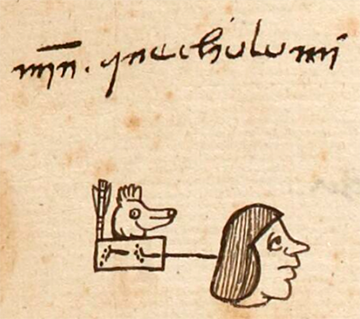
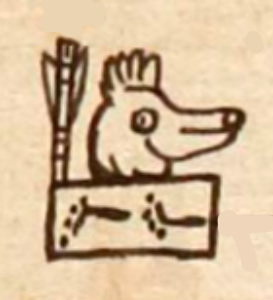
This compound Nahuatl hieroglyph is a black-line drawing of the personal name Quecholomi (with some connection to the Roseate Spoonbill and its pink or feathers), attested here as a man’s name. This compound has three elements: the head of the bird (quecholli), a road (otli), and an arrow (mitl). The first element seems to have a semantic value, whereas the other two are purely phonetic indicators.
Stephanie Wood
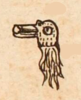
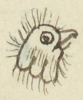
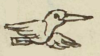
Another Quecholomi from this manuscript (on 24 recto) has only the head of the bird and a cluster of feathers. Neither one is overtly about bones (omitl). This is true, too, of the three examples of the name or its variant (with the absolutive), which are either about the bird or its feathers.
Stephanie Wood
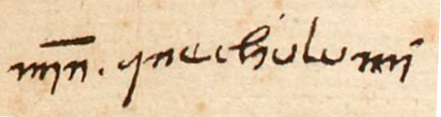
mīn. quecholomi
Martín Quecholomi
Stephanie Wood
1539
Jeff Haskett-Wood
pájaro, pájaros, pluma, plumas rojas, hueso, huesos, rojo, fonetismo, nombres de hombres, men’s names
quecholomi(tl), (referring to the Roseate Spoonbill and its pink or feathers), https://nahuatl.wired-humanities.org/content/quecholomitl
quechol(li), the Roseate Spoonbill or its red/pink feathers, https://nahuatl.wired-humanities.org/content/quecholli
(un nombre que tiene algo que ver con la Espátula Rosada)
Stephanie Wood
Available at Codex Vergara, folio 26r, https://gallica.bnf.fr/ark:/12148/btv1b84528032/f29.item.zoom, accessed 22 February 2026. The Vergara is associated with Tepetlaoztoc, in the larger region of Tetzcoco, c. 1539–1543.
The non-commercial reuse of images from the Bibliothèque nationale de France is free as long as the user is in compliance with the legislation in force and provides the citation: “Source gallica.bnf.fr / Bibliothèque nationale de France” or “Source gallica.bnf.fr / BnF.” We would also appreciate a citation to the Visual Lexicon of Aztec Hieroglyphs, https://aztecglyphs.wired-humanities.org/.