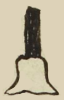
quetzalitztli (FCbk11f204v)
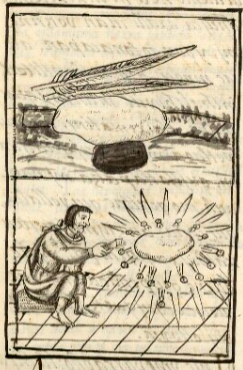
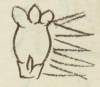
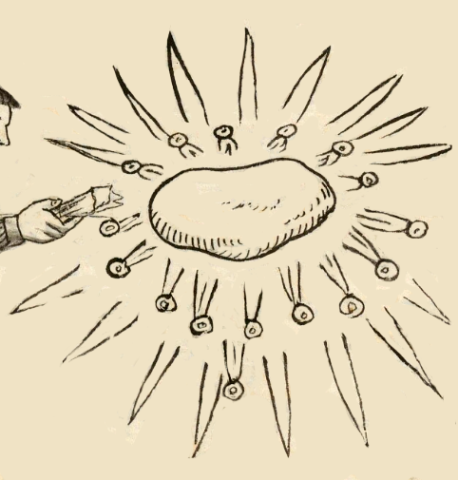
This iconographic example, with some hieroglyphic elements, features an emerald or a green obsidian blade (quetzalitztli). It is included in this digital collection for the purpose of making comparisons with related hieroglyphs. The term selected for this example comes from the text near the image in the Digital Florentine Codex. There is no gloss, per se. This example shows a black-line drawing of a somewhat plain stone with rounded edges. This stone has short streams of water (of a hieroglyphic nature) and long pointed rays (akin to tonalli elements) shooting out from all around its edges. These add considerable movement–perhaps intending shimmer–to the stone. Water may also be present because its droplets can double for precious greenstones (chalchihuitl), and, incidentally, the quetzalchalchihuitl that appears on folio 205 recto has these same short streams of waters spurting out from the stone. On the left edge of the image here (better viewed in the contextualizing image) one can see part of a man’s head and his hand. The hand is holding what may be a tool. Perhaps he has struck the stone or is about to strike the stone in order to begin carving it into gems. The shape of the tool in his hand could be itztli itself, as it can take a rectangular shape (see below). The man is wearing a long-sleeved tunic and long trousers, all with a cloak on top, tied on one shoulder. The fabric is shaded, giving it a three-dimensionality, which reveals European artistic traditions that have influence this tlacuilo. While the clothing reveals European cultural influences, the cloak is Indigenous (called a tilmatli, or tilmahtli, with the glottal stop).
Stephanie Wood
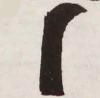
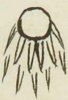
As of December 2025, this collection has no hieroglyphs for quetzalitztli, but it does have both quetzal feathers and obsidian blades (itztli). Short streams of water and sun-like rays are also very well attested. See below, and for more examples, one can use the Quick Search, entering the terms water or tonalli.
Marc Thouvenot and Ónix Acevedo Frómeta refer to the water streams and rays in this sign as though they emit "sudor y resplandece" (sweat and shine). They also argue that the term for this precious stone does not intend to say that it is obsidian, but that is has a similar transparency and density. [See: Chalchihuitl: La piedra verde preciosa en la cultura náhuatl (México: Universidad Nacional Autónoma de México, 2026), p. 71, fig. 33.]
Stephanie Wood
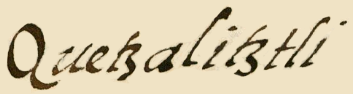
Quetzalitztli
Quetzalitztli
Stephanie Wood
1577
Jeff Haskett-Wood
piedras, esmeraldas, navajas, hojas de obsidiana, joya, joyas, gem, gems
quetzaliz(tli), an emerald or perhaps a green obsidian blade, https://nahuatl.wired-humanities.org/content/quetzalitztli
quetzal(li), quetzal bird feathers, https://nahuatl.wired-humanities.org/content/quetzalli
itz(tli), an obsidian blade or knife, https://nahuatl.wired-humanities.org/content/itztli
la esmeralda, o la piedra de obsidiana de color verde
Stephanie Wood
Available at Digital Florentine Codex/Códice Florentino Digital, edited by Kim N. Richter and Alicia Maria Houtrouw, "Book 11: Earthly Things", fol. 204v, Getty Research Institute, 2023. https://florentinecodex.getty.edu/en/book/11/folio/204v/images/0 Accessed 16 November 2025.
Images of the digitized Florentine Codex are made available under the following Creative Commons license: CC BY-NC-ND (Attribution-NonCommercial-NoDerivs 4.0 International). For print-publication quality photos, please contact the Biblioteca Medicea Laurenziana ([email protected]). The Library of Congress has also published this manuscript, using the images of the World Digital Library copy. “The Library of Congress is unaware of any copyright or other restrictions in the World Digital Library Collection. Absent any such restrictions, these materials are free to use and reuse.”