Tecpaxihuitl (ATno6-1)
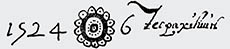
This black-line drawing of the simplex Nahuatl hieroglyph of a year sign for Flint-knife (Tecpaxihuitl) shows a round object with concentric circles and a scalloped edge, something like a flower. The scallops have a black dot in the middle. Inside the scallops is a thick black ring. Inside that is a white ring with smaller black dots. Then another black ring, and a white center with one black dot. The contextualizing image shows that the companion number to this flint knife is "6." Such numbers ran from 1 to 13. The context also shows that this Nahua date coincided with the European year 1524, early into the Spanish colonial enterprise, and five years after this particular annals manuscript starts recording history in this alphabetic format. The use of hieroglyphs for year signs, however, continued for a very long time alongside the adoption of the Roman alphabet by Nahua tlacuilos.
Stephanie Wood
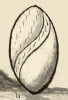
On this same manuscript page, there are two other Tecpaxihuitl signs, one has interior rays and one has a human eye on a dotted background. They are all shaped like flowers, perhaps precious gems, or war shields. Maybe this circular object is more of a xihuitl sign than a tecpatl sign. (See below.) The tecpatl (flint knife) was both a day name and a year name in the calendars. Besides appearing in dates, Tecpatl was a personal name, and it also features in place names, likely in pueblos where flint knives were made or where a landscape feature resembled a flint knife. A Quick Search for "tecpatl" will reveal the usual two-tone, pointed oval shape of the flint knife, nothing like what we see here.
Stephanie Wood
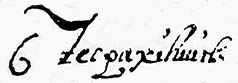
6 Tecpaxihuitl
c. 1720, at the latest
Stephanie Wood
obsidiana, cuchillo, cuchillos, pedernales, joya, joyas, turquesa, turquesas, chalchihuitl, chalchihuites, xiuhpohualli, anales, Frances Krug

tecpa(tl), flint knife, https://nahuatl.wired-humanities.org/content/tecpatl
xihui(tl), year, https://nahuatl.wired-humanities.org/content/xihuitl
el año pedernal
Stephanie Wood
Anales de Tlaxcala, 1519–1720. From a photocopy provided to Frances Krug by the Archivo Histórico del Instituto Nacional de Antropología e Historia. Currently in the Krug collection.
Creative Commons. Permission to publish here was given by BNAH Director Baltazar Brito.