tecpatl (FCbk11f210v)
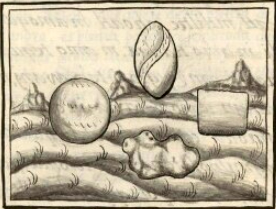
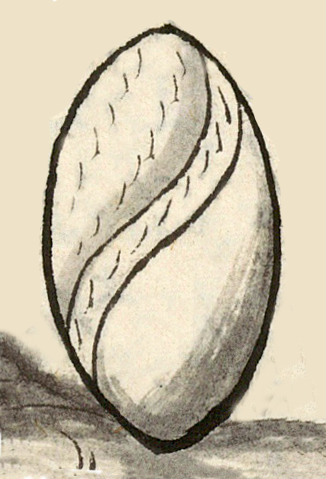
This iconographic example, featuring a black-line drawing of a flint knife (tecpatl), is included in this digital collection for the purpose of making comparisons with related hieroglyphs. The term selected for this example comes from the text near the image in the Digital Florentine Codex. There is no gloss, per se. This example shows the marquise-shaped knife with a point at the top and one at the bottom. A band of white runs diagonally, curving from nearly top to nearly bottom. This stripe has vertical short lines, or hash marks, decorating it. The top half is a light shade of gray, and has two rows of hash marks. The bottom half of the knife is white but shaded toward the bottom, giving it a three-dimensionality (showing European artistic influence). The knife is also sitting on end in a landscape setting, another European artistic influence. The curving diagonal stripe is very reminiscent of the hieroglyph for stone; this may indeed be a hieroglyph for tecpatl, in fact, although we are playing it safe and calling it an example of iconography.
Stephanie Wood
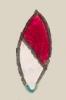
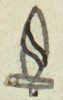
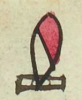
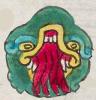
Most tecpatl hieroglyphs are two-toned, usually red and white, if they have coloring. This red and white coloring will lend itself to other sharp objects, such as teeth (like the Cuetzaloztoc glyph has), claws (like the Itztitlan glyph has), or horns (like the Temamauhti has). The line dividing these two halves will often be straight, but sometimes it is curved like this one. Sometimes the tecpatl sits on a crossbar. See some examples below.
Stephanie Wood
tecpatl
Stephanie Wood
1577
Jeff Haskett-Wood
navaja, navajas, pedernales, cuchillo, cuchillos, obsidiana
tecpa(tl), a flint knife, https://nahuatl.wired-humanities.org/content/tecpatl
el pedernal
Stephanie Wood
Available at Digital Florentine Codex/Códice Florentino Digital, edited by Kim N. Richter and Alicia Maria Houtrouw, "Book 11: Earthly Things", fol. 210v, Getty Research Institute, 2023. https://florentinecodex.getty.edu/en/book/11/folio/210v/images/0 Accessed 16 November 2025.
Images of the digitized Florentine Codex are made available under the following Creative Commons license: CC BY-NC-ND (Attribution-NonCommercial-NoDerivs 4.0 International). For print-publication quality photos, please contact the Biblioteca Medicea Laurenziana ([email protected]). The Library of Congress has also published this manuscript, using the images of the World Digital Library copy. “The Library of Congress is unaware of any copyright or other restrictions in the World Digital Library Collection. Absent any such restrictions, these materials are free to use and reuse.”