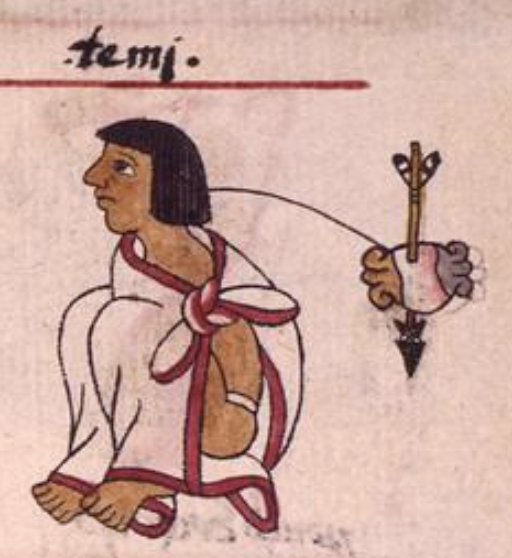
Temi (TK207r)
This painted compound Nahuatl hieroglyph represents the personal name Temi (perhaps “Full”), attested as a man’s name. It shows a vertical arrow (mitl) piercing a stone (tetl). The arrow shows considerable detail. The fletching appears to have black-and-white feathers, possibly from a quail. The point is double. The stone also has been given some interesting detail. It is horizontal, with the curling ends on right and left. The right end is a gray color, and the left is a terracotta color. Vertical lines separate the middle from the ends, and the middle is a pink fading to white. The compound is fully phonetic.
Stephanie Wood
This is the first Temi to enter this digital collection (May 2026). Temic, Temiz, and Temillo are much more popular names for men. One wonders whether this Temi has been apocopated, although it is a perfectly reasonable “dictionary word.”
Side Note: The folio numbers are not always clear in the copy published online by the British Museum. Marc Thouvenot gives this page the number K05_A in his TLACHIA digital collection, https://tlachia.iib.unam.mx/tepetlaoztoc/K05_A.
Stephanie Wood
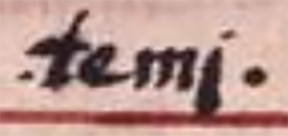
.temi.
Temi
Stephanie Wood
c. 1556
Jeff Haskett-Wood
flecha, flechas, piedra, piedras, nombres de hombres, men’s names, fonetismo
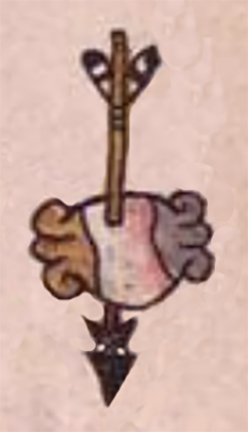
te(tl), stone, https://nahuatl.wired-humanities.org/content/tetl
mi(tl), arrow or dart, https://nahuatl.wired-humanities.org/content/mitl
temi, to fill up or be full, https://nahuatl.wired-humanities.org/content/temi
Lleno
Stephanie Wood
The Codex Kingsborough, also known as the Códice de Tepetlaoztoc, and the Memorial de los indios de Tepetlaoztoc, is not on display. It was transferred from the British Library and is now held by the British Museum. It is shared on line at: https://www.britishmuseum.org/collection/object/E_Am2006-Drg-13964
©The Trustees of the British Museum. Shared under a Creative Commons Attribution-Non-Commercial-ShareAlike 4.0 International (CC BY-NC-SA 4.0) license. Please also cite the <em>Visual Lexicon of Aztec Hieroglyphsem>, ed. Stephanie Wood (Eugene, Ore.: Wired Humanities Projects, 2020-present) and this URL.