tenextli (Osu37v)
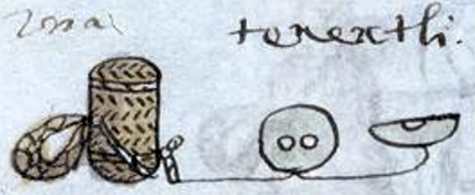
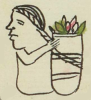
This painted simplex Nahuatl hieroglyph represents tenextli, a load of lime (burned limestone prepared for construction). One cannot see the substance inside the woven mat that wraps around it. Tenextli was a common item that had to be presented to Spanish overlords as a type of tribute (taxation) in kind. This load has what would be called a mecapalli (tumpline with a band for the forehead) already attached to it. This shows how the loads were carried by humans with the weight of the bundle bearing on the head, neck, and back.
Stephanie Wood
The contextualizing image shows the value of this load, which was 2.5 tomines. One tomín was an eighth of a peso. Compare this load to some others, below. And note the examples of places where limestone was burned to make tenextli.
Stephanie Wood
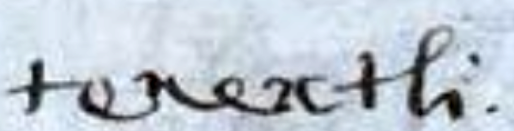
tenextli.
tenextli
Stephanie Wood
1551–1565
Jeff Haskett-Wood
carga, tributo, tributos, mecapal
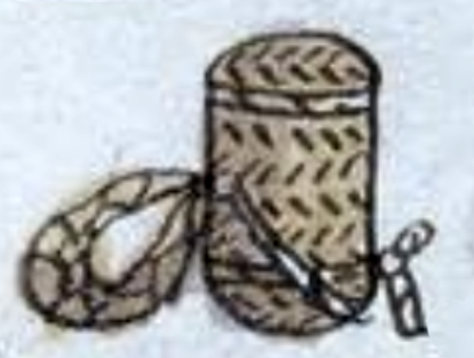
tenex(tli), slaked limestone, https://nahuatl.wired-humanities.org/content/tenextli
mecapal(li), tumpline, https://nahuatl.wired-humanities.org/content/mecapalli
la cal
Stephanie Wood
Library of Congress Online Catalog and the World Digital Library, Osuna Codex, or Painting of the Governor, Mayors, and Rulers of Mexico, https://www.loc.gov/resource/gdcwdl.wdl_07324/. The original is located in the Biblioteca Nacional de España.
"The Library of Congress is unaware of any copyright or other restrictions in the World Digital Library Collection. Absent any such restrictions, these materials are free to use and reuse." But please cite the Biblioteca Nacional de España and this Visual Lexicon of Aztec Hieroglyphs if you use any of these images here or refer to the content on this page, providing the URL