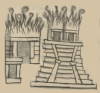
teocalli (FCbk11f240v)
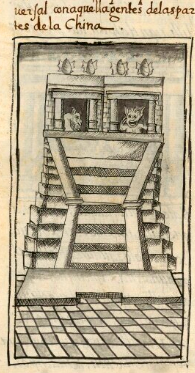
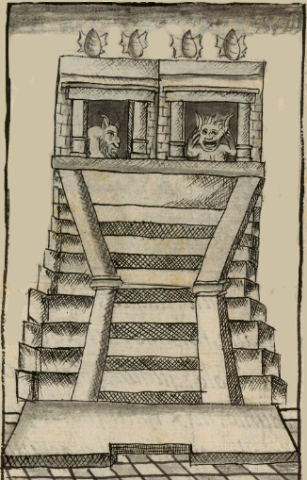
This iconographic example, featuring a black and white sketch of a religious temple (teocalli), is included in this digital collection for the purpose of making comparisons with related hieroglyphs. The term selected for this example comes from the text on the page preceding the image in the Digital Florentine Codex. There is no gloss, per se. This example shows a temple with two buildings on the top, which was how the main temple at Mexico-Tenochtitlan was structured. It is like a tower with steps on all sides. The front steps have a framing that starts out wide at the bottom, narrows in the middle, and widens again at the top. The steps are shaded, giving them three-dimensionality, a European artistic introduction. The foreground shows a paved floor with pieces of stone in alternating dark and light colors. The small buildings above the steps have rooms where figures appear. These figures represent divine or sacred forces, although the text calls them diablome (devils, using a Spanish loan with a Nahuatl plural attached at the end), showing the influence of Christianity on the Nahua writer. Likewise, other terms for these figures (and as translated by Anderson and Dibble) are: ixiptlatl (image), tzitzimitl (demon), and colelectli (a certain demon, according to Alonso de Molina). The one on the right appears on a frontal view, from chest up, darkened hands raised to its face, mouth open, and it has pointed ears on the top of its animal-like head. The figure on the left appears in a profile view, chest up, facing toward the viewer’s right. It looks something like a bearded goat. The roofs of the buildings have two horizontal layers, and on top of each roof are two (what appear to be) shells or butterflies. Above this crenelation is a darker sky band. The “house,” with one long room or a row of rooms, not only contains the divine force but also its belongings. The text refers to it as a place to show and exhibit.
Stephanie Wood
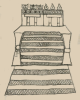
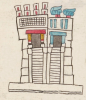
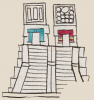
This teocalli is not identical to the others in this collection that have a pair of buildings on top. These all deserve further comparison and study. See below for other examples. Cities that had pyramids with dual buildings on top included, for example, Tenochtitlan, Tlatelolco, and Tenayuca.
Stephanie Wood
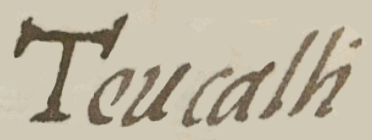
Teucalli
teocalli
Stephanie Wood
1577
Jeff Haskett-Wood
templo, templos, arquitectura, estructuras, casas, capillas, estrella, estrellas, stars, water, agua, pirámide, pirámides, crenelación, crestería, templo, templos, arquitectura, estructuras, casas, capillas, pirámide, pirámides, crenelación, crestería, almena, almenas
teocal(li), temple, https://nahuatl.wired-humanities.org/content/teocalli
el templo
Stephanie Wood
Available at Digital Florentine Codex/Códice Florentino Digital, edited by Kim N. Richter and Alicia Maria Houtrouw, "Book 11: Earthly Things", fol. 240v, Getty Research Institute, 2023. https://florentinecodex.getty.edu/en/book/11/folio/240v/images/0 Accessed 16 November 2025.
Images of the digitized Florentine Codex are made available under the following Creative Commons license: CC BY-NC-ND (Attribution-NonCommercial-NoDerivs 4.0 International). For print-publication quality photos, please contact the Biblioteca Medicea Laurenziana ([email protected]). The Library of Congress has also published this manuscript, using the images of the World Digital Library copy. “The Library of Congress is unaware of any copyright or other restrictions in the World Digital Library Collection. Absent any such restrictions, these materials are free to use and reuse.”