Tepolohuatl (TK207v)
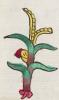
This painted compound Nahuatl hieroglyph represents the personal name Tepoloa (“He Destroys People”), a local leader. Gordon Whittaker (2021, 95) translates the name. The compound has four elements. The reading order is generally downward. It starts with the phonetic syllable Te- from lips (tentli) in profile facing left. In front of the partial face that includes the lips are four gray smoke (poctli) curls. The smoke supplies the -po- phonetic syllable for the start of the verb in the middle of the name. Below the smoke and lips is a horizontal stalk of maize (ohuatl), somewhat reddish with white leaves. This provides the disyllabogram, -ohua-, which is a phonetic contribution for the last part of the verb poloa. Finally, at the lower end of the compound is the noun tzintli (rear end or buttocks of a man) that serves to supply the phonetic syllable -tzin for the reverential suffix (a significant but apparently inadvertent omission from the gloss).
Stephanie Wood
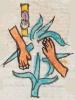
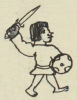
Poloa is a verb that appears in various glyphs in this collection. See a couple of examples below. Over time, tepoloa increasingly became equated with the translation “conquistar” (to conquer), a term especially associated with the Spanish colonizers and their Indigenous allies.
Side Note: The folio numbers are not always clear in the copy published online by the British Museum. Marc Thouvenot gives this page the number K05_B in his TLACHIA digital collection, https://tlachia.iib.unam.mx/tepetlaoztoc/K05_B.
Stephanie Wood
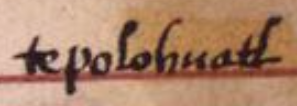
tepolohuatl.
Tepoloatl
Stephanie Wood
c. 1556
Jeff Haskett-Wood
destruir, conquista, matar, humo, labios, tallo, maíz, planta, plantas, nombres de hombres, men’s names, fonetismo
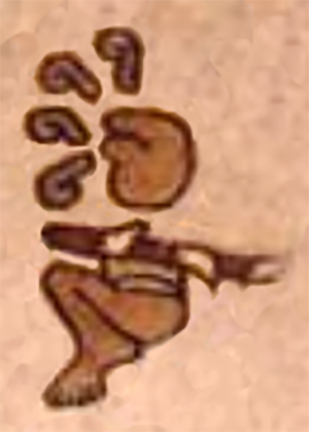
poloa, to destroy, https://nahuatl.wired-humanities.org/content/poloa
te-, nonspecific human object prefix, people, https://nahuatl.wired-humanities.org/content/te
ohua(tl), a maize stalk, https://nahuatl.wired-humanities.org/content/ohuatl
tzin(tli), rear end, buttocks, https://nahuatl.wired-humanities.org/content/tzintli
-tzin, locative suffix, little, lower, or a spinoff, https://nahuatl.wired-humanities.org/content/tzin
Él Que Destruye a la Gente
Stephanie Wood
The Codex Kingsborough, also known as the Códice de Tepetlaoztoc, and the Memorial de los indios de Tepetlaoztoc, is not on display. It was transferred from the British Library and is now held by the British Museum. It is shared on line at: https://www.britishmuseum.org/collection/object/E_Am2006-Drg-13964
©The Trustees of the British Museum. Shared under a Creative Commons Attribution-Non-Commercial-ShareAlike 4.0 International (CC BY-NC-SA 4.0) license. Please also cite the <em>Visual Lexicon of Aztec Hieroglyphsem>, ed. Stephanie Wood (Eugene, Ore.: Wired Humanities Projects, 2020-present) and this URL.