tezcahuauhtli (FCbk11f253r)
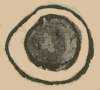
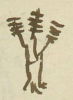
This is a black and white sketch of the compound glyph for an especially dark amaranth plant (tezcahuauhtli). The term selected for this example comes from the text on the page previous to the image in the Digital Florentine Codex. There is no gloss, per se. The contextualizing image shows a leafy plant with four thin stalks, visible roots, and four brush-like flowers at the tips of the stalks. The leaves have veins. The landscape setting and shading show European artistic influences. In the contextualizing image, the compound glyph appears to the right of the plant. It is a close-up detail of one flower on a short sprig with just one leaf. This is apparently the element amaranth (huauhtli). In the middle of the flower are two clear hieroglyphs consisting of a stone (tetl), with its curling ends and wavy, double-diagonal line across the middle, and above that a mirror (tezcatl) with a black center and a white ring around it.
Stephanie Wood
Two of the three elements of this compound hieroglyph are drawn in a way that would be recognizable in the Codex Mendoza of c. 1541, although this effort is seemingly from decades later. The stone provides the phonetic syllable te-, to ensure that the reading would begin with that sound. The tezcatl provides the start to the name of the plant, but it also has a semantic value that refers to the dark color of the plant. The huauhtli is more of a botanical drawing than a hieroglyph, although it functions as part of the compound. A short Spanish-language explanation states that the amaranth is black. The Nahuatl text says that these amaranth seeds are shiny and black. In the Florentine Codex, huauhtli plant variations are numerous, but the drawings often look remarkably alike. The use of compound hieroglyphs next to the plants helps clarify which plant is which, although several have no hieroglyphs.
Stephanie Wood
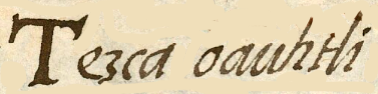
Tezca oauhtli
tezcahuauhtli
Stephanie Wood
1577
Jeff Haskett-Wood
espejo, espejos, piedra, piedras, colores, comida, semilla, semillas
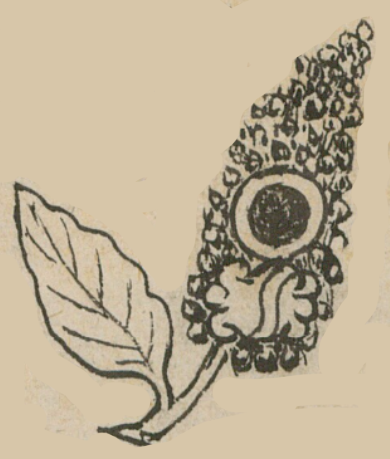
tezcatl, mirror, https://nahuatl.wired-humanities.org/content/tezcatl
huauhtli, amaranth, https://nahuatl.wired-humanities.org/content/huauhtli
el amaranto negro
Stephanie Wood
Available at Digital Florentine Codex/Códice Florentino Digital, edited by Kim N. Richter and Alicia Maria Houtrouw, "Book 11: Earthly Things", fol. 253r, Getty Research Institute, 2023. https://florentinecodex.getty.edu/en/book/11/folio/XXX/images/0 Accessed 16 November 2025.
Images of the digitized Florentine Codex are made available under the following Creative Commons license: CC BY-NC-ND (Attribution-NonCommercial-NoDerivs 4.0 International). For print-publication quality photos, please contact the Biblioteca Medicea Laurenziana ([email protected]). The Library of Congress has also published this manuscript, using the images of the World Digital Library copy. “The Library of Congress is unaware of any copyright or other restrictions in the World Digital Library Collection. Absent any such restrictions, these materials are free to use and reuse.”