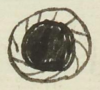
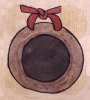
tezcatlalli (FCbk11f216r)
This compound hieroglyph refers to the powder made from grinding up polished obsidian stones that were used for mirrors (tezcatlalli). The compound includes two elements. At the top is a mirror with a loop at the top for hanging and a frontal view of a human (male) face. The mirror also appears to have a frame around it. Below the mirror is a bowl of what must be the powder or sand that was made from grinding the mirror stone. The bowl is three-dimensional, suggesting European artistic influence. The label for this glyph comes from the text near the image in the Digital Florentine Codex. It is shown in a group of signs, not really a hieroglyphic text, referring to various items mentioned in the text, including a book, among other things.
Stephanie Wood
The frame around the mirror may represent a colonial innovation, but this requires further research. [See Ian Mursell, “See and Be Seen,” Mexicolore.] Also, this is the first hieroglyph or glyphic element of a mirror in this digital collection that shows it was conceptualized (at least by the last third of the sixteenth century) as something being used for viewing a face. Frontal views of faces are rather rare in this collection, seemingly preserved for divinities or supernatural beings. In pre-contact Nahua culture, mirrors were associated with Tezcatlipoca (“Smoking Mirror”), who was believed to be able to view all that was going on in the world by using his mirror. [See Aztecs, Eduardo Matos Moctesuma and Felipe Solis Olguín, eds. (2002), 473.] In Classic-period Teotihuacan and the Maya zone, mirrors seem to have been viewed as supernatural portals, and they were placed in bowls, symbolically representing water, which could also reflect things, of course. [See Karl Taube’s work on mirrors in Art, Ideology, and the City of Teotihuacan, Janet Catherine Berlo, ed., (2003), 115.] Viewing one’s own face, while surely practiced by Nahuas, was perhaps more of a vanity concept in European cultures and more of a religious one among Nahuas. Finally, the use of the term tlalli for ground stone adds another meaning to the many translations, which more commonly refer to a piece of land, land in general terms, a region, and the Earth.
Stephanie Wood
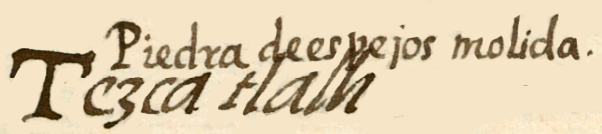
Tezca tlalli [and written above: “Piedra de espejas molida.”]
tezcatlalli
Stephanie Wood
1577
Jeff Haskett-Wood
ground mirror stone, piedras molidas, polvo, arena, cuenco, pulir, limpiar, lijar
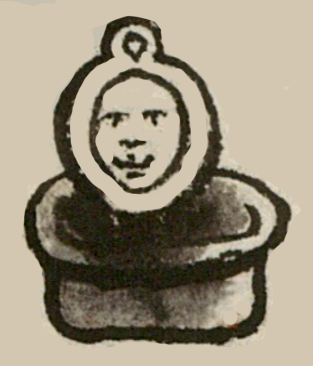
tezcatlal(li), powder made from grinding mirror stones, https://nahuatl.wired-humanities.org/content/tezcatlalli
la piedra molida de espejos
Stephanie Wood
Available at Digital Florentine Codex/Códice Florentino Digital, edited by Kim N. Richter and Alicia Maria Houtrouw, "Book 11: Earthly Things", fol. 216r, Getty Research Institute, 2023. https://florentinecodex.getty.edu/en/book/11/folio/216r/images/0 Accessed 16 November 2025.
Images of the digitized Florentine Codex are made available under the following Creative Commons license: CC BY-NC-ND (Attribution-NonCommercial-NoDerivs 4.0 International). For print-publication quality photos, please contact the Biblioteca Medicea Laurenziana ([email protected]). The Library of Congress has also published this manuscript, using the images of the World Digital Library copy. “The Library of Congress is unaware of any copyright or other restrictions in the World Digital Library Collection. Absent any such restrictions, these materials are free to use and reuse.”