Tlacamazatl (TK207r)
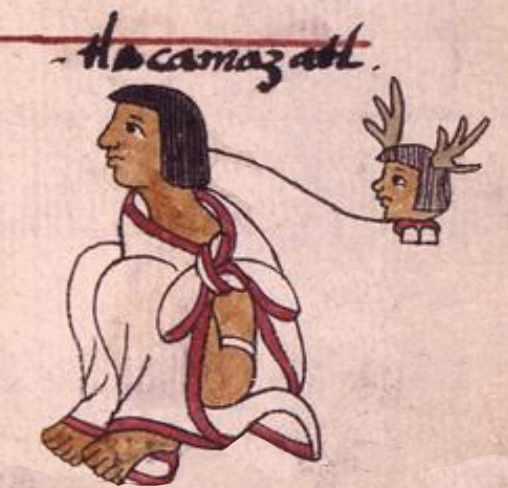
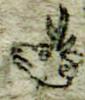
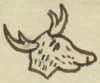
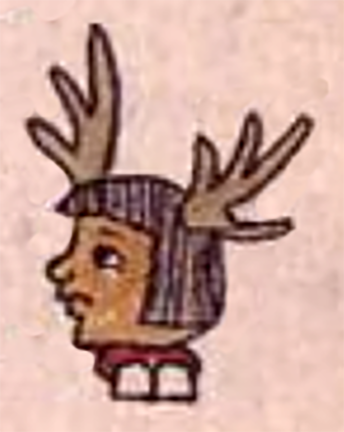
This painted compound Nahuatl hieroglyph represents the personal name Tlacamazatl (“Brute” or “Beastly Man”), and, not surprisingly, attested as a man’s name. It has three elements, and the reading order is upward. A pair of white front teeth (tlantli) with red gums above are the first element, and the teeth provide the phonetic syllable (-tla-) at the start of the name. Above the teeth is a human (tlacatl) head, actually a man, in profile facing left, reiterating the -tla- and adding -ca-. Attached to the human head are deer (mazatl) antlers, which contribute the final two syllables of the name. While one could imagine this name translating literally as Human-Deer, the definition provided by Alonso de Molina in our Online Nahuatl Dictionary is a “brute” or a “bestial man.” Frances Karttunen suggests “someone rabid, vicious.”
Stephanie Wood
The tlacatl and mazatl still do contribute semantically to the reading of a bestial man, so this is not exactly a name glyph that is “fully phonographic.” But it is close. This is the first Tlacamazatl name to enter this digital collection (as of May 2026). It is not the same, but Mazatl is a popular name given its being a day name in the tonalpohualli calendar.
Side Note: The folio numbers are not always clear in the copy published online by the British Museum. Marc Thouvenot gives this page the number K05_A in his TLACHIA digital collection, https://tlachia.iib.unam.mx/tepetlaoztoc/K05_A.
Stephanie Wood
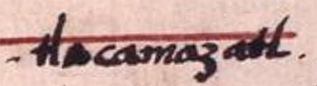
.tlacamazatl.
Tlacamazatl
Stephanie Wood
c. 1556
Jeff Haskett-Wood
nombres de hombres, men’s names, bestias, ciervo, ciervos, cuernos, dientes, fonetismo
tlan(tli), teeth, https://nahuatl.wired-humanities.org/content/tlantli
tlaca(tl), person, https://nahuatl.wired-humanities.org/content/tlacatl
maza(tl), deer, https://nahuatl.wired-humanities.org/content/mazatl
Hombre Bestial
Stephanie Wood
The Codex Kingsborough, also known as the Códice de Tepetlaoztoc, and the Memorial de los indios de Tepetlaoztoc, is not on display. It was transferred from the British Library and is now held by the British Museum. It is shared on line at: https://www.britishmuseum.org/collection/object/E_Am2006-Drg-13964
©The Trustees of the British Museum. Shared under a Creative Commons Attribution-Non-Commercial-ShareAlike 4.0 International (CC BY-NC-SA 4.0) license. Please also cite the <em>Visual Lexicon of Aztec Hieroglyphsem>, ed. Stephanie Wood (Eugene, Ore.: Wired Humanities Projects, 2020-present) and this URL.