Tlacochin (TK206v)
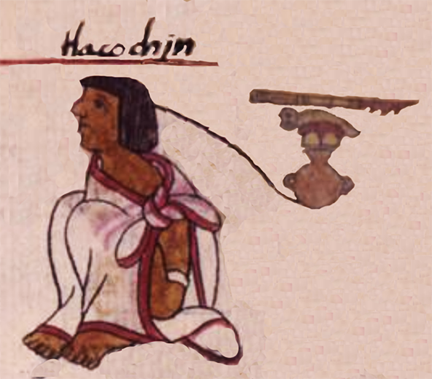
This painted compound Nahuatl hieroglyph represents the personal name Tlacochin (“Javelin”), attested here as a man’s name. It has four elements, and the reading order is multidirectional. The key element, a javelin (tlacochin or tlacochtli) is at the top. This could be sufficient to represent the name, but the tlacuilo added some phonetic elements to ensure the reader did not interpret the name as mitl (arrow), for example, which the tlacochin can resemble. Below the tlacochin is a type of earthworm called icochin, which serves as a disyllabogram (-cochin) as Gordon Whittaker explains (2021, Figure 4.6). Below that is a pair of white teeth (tlantli) with red gums. This element supplies the -tla- phonetic syllable that is the start to the name. Finally, below the teeth is a pottery vessel called a comitl, which provides the -co- phonetic syllable in the middle of the name. Incidentally, the original contextualizing image was badly stained, so it has been digitally washed to improve the reading of the hieroglyph.
Stephanie Wood
The personal name Tlacochin was an extremely popular one, at least in Huexotzinco, as a Quick Search will confirm. Tlacochtli is a variant spelling for the weapon. Whittaker says that the term tlacochin is older, but it was preserved through personal naming practices.
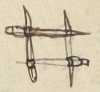
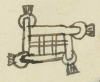
Sometimes four javelins were tied together at right angles to create a structure (see below). This deserves further research.
Side Note: The folio numbers are not always clear in the copy published online by the British Museum. Marc Thouvenot gives this page the number K04_B in his TLACHIA digital collection, https://tlachia.iib.unam.mx/tepetlaoztoc/K04_B.
Stephanie Wood
tlacochin
Tlacochin
Stephanie Wood
c. 1556
Jeff Haskett-Wood
jabalinas, flechas, púas, armas, dientes, cerámica, barro, gusano, gusanos
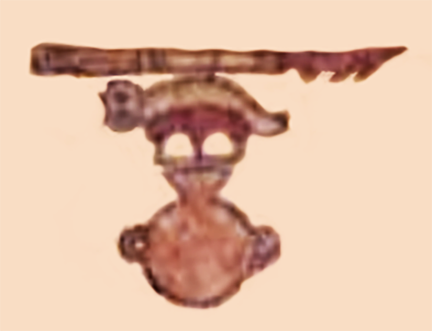
tlacoch(in), javelin, https://nahuatl.wired-humanities.org/content/tlacochin
icoch(in), a type of earthworm, https://nahuatl.wired-humanities.org/content/icochin
tlan(tli), teeth, https://nahuatl.wired-humanities.org/content/tlantli
com(itl), pottery jug or pot, https://nahuatl.wired-humanities.org/content/comitl
-co, locative suffix, in or at, https://nahuatl.wired-humanities.org/content/co
Jabalina
Stephanie Wood
The Codex Kingsborough, also known as the Códice de Tepetlaoztoc, and the Memorial de los indios de Tepetlaoztoc, is not on display. It was transferred from the British Library and is now held by the British Museum. It is shared on line at: https://www.britishmuseum.org/collection/object/E_Am2006-Drg-13964
©The Trustees of the British Museum. Shared under a Creative Commons Attribution-Non-Commercial-ShareAlike 4.0 International (CC BY-NC-SA 4.0) license. Please also cite the <em>Visual Lexicon of Aztec Hieroglyphsem>, ed. Stephanie Wood (Eugene, Ore.: Wired Humanities Projects, 2020-present) and this URL.