tlapitzqui (LTlaxUT1a)
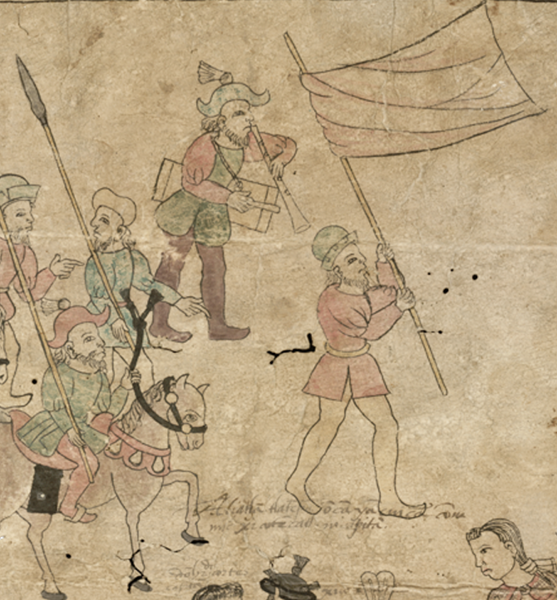
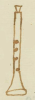
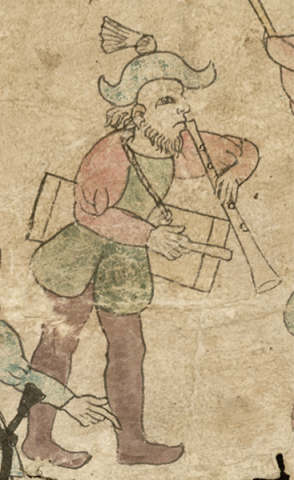
This iconographic example is included here for possible comparisons with Nahuatl hieroglyphs. It shows a Spanish musician playing a flute and a drum. He wears a red shirt under a green sleeveless tunic. The tunic extends to mid-thigh over top of some brown leggings, worn with brown shoes. The musician (perhaps seen as a tlapitzqui) also has a turquoise blue hat with a white tassel on top. He has a beard and his hair is somewhat long on his neck. The flute that he holds in his left hand has about five finger holes. It is flared at the lower end, away from the man’s face. The drum, which he carries by way of a cord or rope that is over his right shoulder and cuts across his body, is nearly horizontal. It is probably made of wood. The musician holds a stick in his right hand. He would have been hitting the drum with this stick. His feet are separated and he leans forward as though he is playing music while he walks.
Stephanie Wood
We are using the Nahuatl name here for a musician, especially for a flute player, but there is no gloss to assure us that the Nahuas would have referred to him this way. As was perhaps customary for an expeditionary force, the musician is led by a flag bearer in the contextualizing image. They were likely trying to boost morale.
Stephanie Wood
1540s
Jeff Haskett-Wood
flauta, chirimía, tambor, músico, música, español, castellano, marchar, marcha, toca, tocar,
tlapitzqui, a musician or a flautista, https://nahuatl.wired-humanities.org/content/tlapitzqui
músico o flautista
Stephanie Wood
Benson Latin American Collection, LLILAS Benson Latin American Studies and Collections, The University of Texas at Austin https://collections.lib.utexas.edu/catalog/utblac:3c754fd0-b27f-4af7-9cf...
The Benson Library has kindly provided the digital images and permission to put them into our Mapas Project in 2015. Use and reproduction from this project: https://creativecommons.org/publicdomain/mark/1.0/, but please also cite the Visual Lexicon of Aztec Hieroglyphs, ed. Stephanie Wood, (Eugene, Ore.: Wired Humanities Projects, ©2020-present). Version 1.0.