tlatlilania (FCbk11f219v)
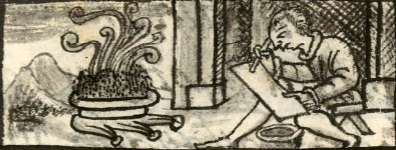
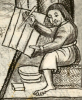
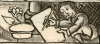
This iconographic example, featuring an example of making black lines on something (or writing) (tlatlilania), is included in this digital collection for the purpose of making comparisons with related hieroglyphs. The term selected for this example comes from the text near the image in the Digital Florentine Codex. There is no gloss, per se. This example shows a probable Nahua man, probably a tlacuilo, sitting on a stool, holding a large piece of paper and a writing or painting implement, and intently looking at what he is doing (poised to write or paint). Curiously, the tool lacks a point or a brush on the tip. The man is dressed in a collared, belted tunic that is shaded, giving it three-dimensionality. On the floor next to the man is a bowl or pot of black paint (according to the text) presumably to be applied to the paper (or possibly canvas). The contextualizing image shows the processing of the black pigment. A hieroglyph of water appears below that larger pot, and smoke curls upward from the larger pot, very reminiscent of popoca and poctli (smoke) glyphs.
Stephanie Wood
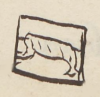
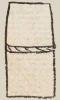
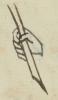
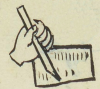
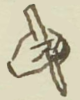
See some other papers–plus writing or painting tools–in the glyphs provided for comparative purposes, below.
Stephanie Wood
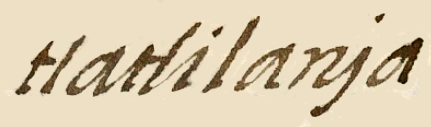
tlatlilania
Stephanie Wood
1577
Jeff Haskett-Wood
pintar, escribir, pintando, escribiendo, papel, tela, lienzo, negro, pintura negra, tinta, writing, painting
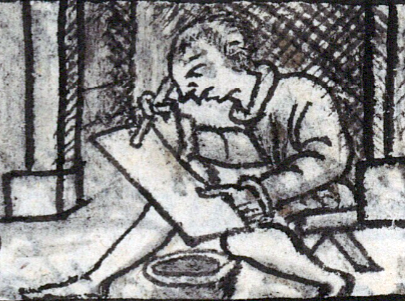
tlatlilania, to make black lines on something, https://nahuatl.wired-humanities.org/content/tlatlilania
hacer líneas negras sobre algo
Stephanie Wood
Available at Digital Florentine Codex/Códice Florentino Digital, edited by Kim N. Richter and Alicia Maria Houtrouw, "Book 11: Earthly Things", fol. 219v, Getty Research Institute, 2023. https://florentinecodex.getty.edu/en/book/11/folio/219v/images/0 Accessed 16 November 2025.
Images of the digitized Florentine Codex are made available under the following Creative Commons license: CC BY-NC-ND (Attribution-NonCommercial-NoDerivs 4.0 International). For print-publication quality photos, please contact the Biblioteca Medicea Laurenziana ([email protected]). The Library of Congress has also published this manuscript, using the images of the World Digital Library copy. “The Library of Congress is unaware of any copyright or other restrictions in the World Digital Library Collection. Absent any such restrictions, these materials are free to use and reuse.”