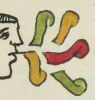
tlatoa (Osu2v)
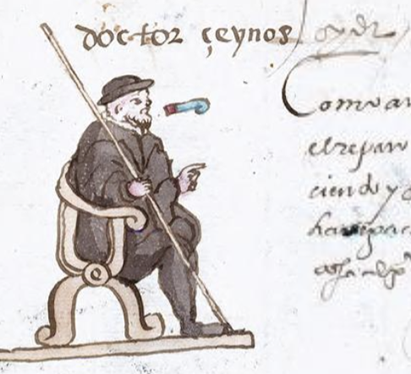
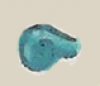
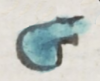
This painted simplex Nahuatl hieroglyph represents the verb tlatoa and its extension, the noun tlatoani (literally, one who speaks, i.e., the ruler). It is a reference to the nature of the speech and the man who is speaking, Dr. Ceynos, a judge of the high court (Audiencia), a Spanish colonial overlord to whom Nahuas had to provide tribute in kind. A tlatoani (or tlahtoani, with the glottal stop) was normally a Nahua ruler, but the authority of the figure who appears in the contextualizing image has earned him this symbol for his speech. The hieroglyph is a simple speech scroll or volute that comes out horizontally from the man’s mouth. The tip of the volute nearest to the speaker is red and then it changes to blue, which runs through the curling part. Most such scrolls are blue if they are colored at all. The red tip–while found in this manuscript in many places–is rare, and its meaning is elusive. Suggestions are welcomed.
Stephanie Wood
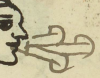
See two other blue speech scrolls for tlatoa below. A rare, multi-colored array of volutes is captured by Chachalacatl, also below. In the Advanced Search, one can request to see “Cultural Content” and choose “Speech” and receive a great variety of types of scrolls. Some will stand for tlatoa, tlatolli (word, speech, statement, discourse, etc.), tlahuel (a greeting or a conjuring expression), nahuatl (language), and other vocabulary terms.
Stephanie Wood
1551–1565
Jeff Haskett-Wood
oidor, corte, tributo

tlatoa, to speak, https://nahuatl.wired-humanities.org/content/tlatoa
tlatoani, ruler, https://nahuatl.wired-humanities.org/content/tlatoani
hablar, o el hablador, el gran señor
Stephanie Wood
Library of Congress Online Catalog and the World Digital Library, Osuna Codex, or Painting of the Governor, Mayors, and Rulers of Mexico, https://www.loc.gov/resource/gdcwdl.wdl_07324/. The original is located in the Biblioteca Nacional de España.
"The Library of Congress is unaware of any copyright or other restrictions in the World Digital Library Collection. Absent any such restrictions, these materials are free to use and reuse." But please cite the Biblioteca Nacional de España and this Visual Lexicon of Aztec Hieroglyphs if you use any of these images here or refer to the content on this page, providing the URL.