tlecuezalotl (FCbk12f1r)
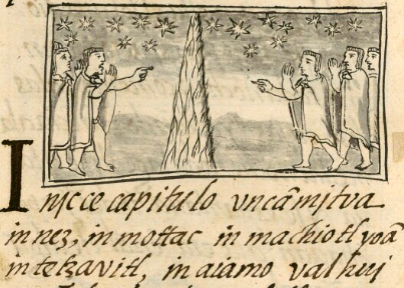
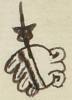
This iconographic example, featuring a black and white sketch of a towering tongue of fire (tlecuezalotl), is included in this digital collection for the purpose of making comparisons with related hieroglyphs. The term selected for this example comes from the text near the image in the Digital Florentine Codex. There is no gloss, per se. The contextualizing image shows a group of five Nahua men, three on the viewer’s right and two on the left, wearing cloaks and loincloths, facing a large tongue of fire full of tiny flames, shooting up into the sky, which is filled with starts. The Nahuatl text relays that the towering tongue of fire (tlecuezalotl) was wide at the bottom (on the ground) and narrow at the top (in the sky), and it resembled the “light of dawn.” Alonso de Molina’s Spanish translation calls it a “bonfire” and “flames of fire.” The whole scene is depicted in a rectangular box, and the tongue of fire goes completely from the bottom lines to the top lines. In all there are probably more than twenty flames that comprise this fire. They look almost like feathers. The text explains that this was a frightening omen that occurred ten years before the Spaniards landed on the coast of Mexico. The men watching this huge fire were pointing at it and, according to the keywording team of the Digital Florentine Codex, they were ululating (making a sound while hitting their lips with their hands), which was called tenhuitequi in Nahuatl. The scene of this omen has a gray grounding band of earth and a gray sky band. The sky band contains seventeen white stars, painted in a European way, each one with six or seven points.
Stephanie Wood
This is the first tlecuezalotl to enter this digital collection (in February 2026), but since the text also calls it a tetzahuitl, we are including some glyphs of the name Tetzauh and some other iconographic examples of omens that were startling (tezahuitl). For comparisons between this tongue of fire and other significant flames, do an Advanced Search for glyph names that start with “tle,” and another one for names starting “tlachinol.”
Stephanie Wood
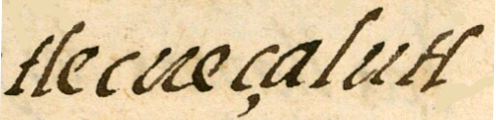
tlecueçalutl
tlecuezalotl
Stephanie Wood
1577
Jeff Haskett-Wood
presagio, presagios, aguero, agueros, cosa espantosa, cosas espantosas
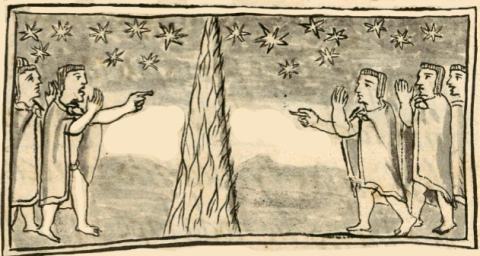
tlecuezalo(tl), a tongue of fire, https://nahuatl.wired-humanities.org/content/tlecuezalotl
tetzahu(itl), a supernatural; an omen, augury, or auguries, https://nahuatl.wired-humanities.org/content/tetzahuitl
el agüero, las llamas de fuego
Stephanie Wood
Available at Digital Florentine Codex/Códice Florentino Digital, edited by Kim N. Richter and Alicia Maria Houtrouw, "Book 6: Rhetoric and Moral Philosophy", fol. 214r, Getty Research Institute, 2023. https://florentinecodex.getty.edu/en/book/6/folio/214r/images/0 Accessed 10 July 2025.
Images of the digitized Florentine Codex are made available under the following Creative Commons license: CC BY-NC-ND (Attribution-NonCommercial-NoDerivs 4.0 International). For print-publication quality photos, please contact the Biblioteca Medicea Laurenziana ([email protected]). The Library of Congress has also published this manuscript, using the images of the World Digital Library copy. “The Library of Congress is unaware of any copyright or other restrictions in the World Digital Library Collection. Absent any such restrictions, these materials are free to use and reuse.”