Topalcehual (Verg25r)
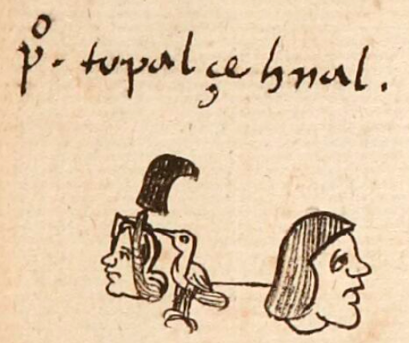
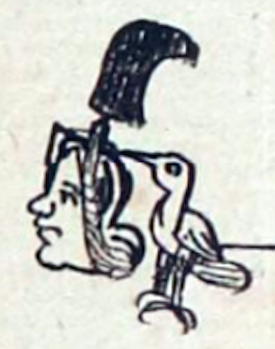
This compound Nahuatl hieroglyph is a black-line drawing of the personal name Topalcehual (perhaps, “Our Black Shadow”), attested here as a man’s name. The compound seems to be fully phonetic, with the To- deriving from the bird (tototl), the -pal- from the word for black (palli), and the -cehual from the near homophone cihuatl. An alternative reading could be “Our Black Woman.”
Stephanie Wood
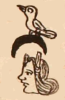
The pretentious element (topal) does not seem required in the analysis, but further research could help clarify the meaning of this name. In the compound hieroglyph for Topalcehual on folio 23 recto, the black element is a crescent shape, whereas here it is something of a hook. Perhaps both items are carved obsidian, and they both speak to the color black.
Stephanie Wood
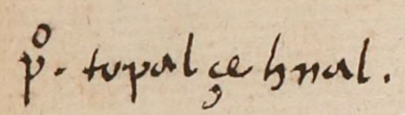
po. topalçehual
Pedro Topalcehual
Stephanie Wood
1539
Jeff Haskett-Wood
mujer, mujeres, negro, pájaro, pájaros, creciente, crecientes, fonetismo, nombres de hombres, men’s names
to-, first person plural possessive, “our,” https://nahuatl.wired-humanities.org/node/175783
pal(li), black, https://nahuatl.wired-humanities.org/content/palli
cehual(li), the shadow cast by something, https://nahuatl.wired-humanities.org/content/cehualli
cihua(tl), a woman, https://nahuatl.wired-humanities.org/content/cihuatl
topal, pretentious, presumptuous, https://nahuatl.wired-humanities.org/content/topal
posiblemente, Nuestra Sombra Negra
Stephanie Wood
Available at Codex Vergara, folio 25r, https://gallica.bnf.fr/ark:/12148/btv1b84528032/f57.item.zoom, accessed 22 February 2026. The Vergara is associated with Tepetlaoztoc, in the larger region of Tetzcoco, c. 1539–1543.
The non-commercial reuse of images from the Bibliothèque nationale de France is free as long as the user is in compliance with the legislation in force and provides the citation: “Source gallica.bnf.fr / Bibliothèque nationale de France” or “Source gallica.bnf.fr / BnF.” We would also appreciate a citation to the Visual Lexicon of Aztec Hieroglyphs, https://aztecglyphs.wired-humanities.org/.