totecuiyo ichan (FCbk11f243r)
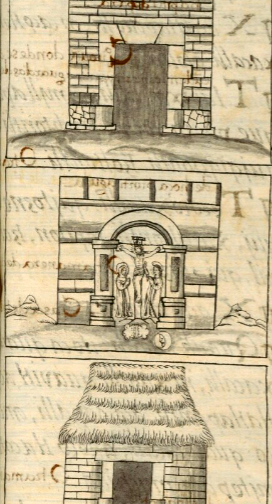
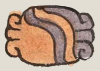
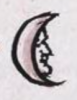
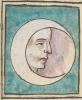
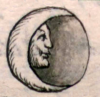
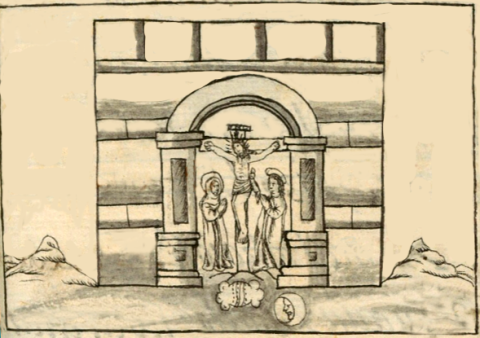
This iconographic example, featuring a chapel devoted to Jesus Christ (totecuiyo ichan), is included in this digital collection for the purpose of making comparisons with related hieroglyphs. The term selected for this example comes from the text near the image in the Digital Florentine Codex. There is no gloss, per se. This example shows a frontal view of a chapel (described in Spanish as an hermita) that has both Indigenous and European architectural characteristics. The entrance is an arch supported with columns. Inside the arch is a figure of Christ on a cross with what may be two friars. On Christ’s left is a robed man with a hood and a halo; his hands are in prayer. On the right of Christ is another robed man; this one has long hair and he has his hands in prayer, too. Other than these contents, the building looks much like a calli. This building is set in a landscape setting, which is a European artistic technique the tlacuilo must have learned from a colonial instructor. Especially interesting is the presence of two Nahuatl hieroglyphs, a stone (tetl) and a moon (metztli), on the platform just outside the chapel. These apparently refer to a place name Anderson and Dibble spell as “Temitztla,” changing the “e” to “i,” as a location of a chapel devoted to Christ; another one is said to be at Anahuac (Mexico City or somewhere on the coast?). The moon is drawn in a European manner, with a face rather than a rabbit, which was the Nahua pre-contact way.
Stephanie Wood
The visual representation of the “home of Our Lord” emphasizes one location over the other by adding the hieroglyphs. Anahuac is not spelled out in glyphs, only what may have really been Temetztlan. There was a Temetztlan in what is now the state of Jalisco–mentioned in a Nahuatl letter to the Spanish king in 1556–see Miguel Figueroa Saavedra, “Carta de los indios naturales de Tochpan al rey,” Estudios de Cultura Náhuatl 63 (enero-junio 2022), 193–225. But, further research seems warranted to determine the location and history of the Temetztlan referenced here. Is it possible that only two chapels were devoted to Christ at the time the Florentine Codex was written? If there were more, which seems likely, why were these two singled out? Were they still sites of worship of a pre-contact divinity? Nowhere in the text at this point is Jesus Christ mentioned as “Our Lord.” He is only pictured. In this digital collection, there is one crucifix (see below) and no one named Jesus or Christ. While one might expect the Virgin Mary to figure more prominently, she is not so named or pictured yet, either (as of February 2026).
Stephanie Wood
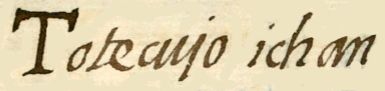
Totecuio ichan
totecuiyo ichan
Stephanie Wood
1577
Jeff Haskett-Wood
hermitas, capilla, capillas, Jesu Cristo, crucifijo, crucifijos, fraile, frailes, túnicas, capucha, jeroglíficos, piedra, piedras, luna, lunas
totecuiyo ichan, the home of our lord, https://nahuatl.wired-humanities.org/content/totecuiyo-ichan
Stephanie Wood
Available at Digital Florentine Codex/Códice Florentino Digital, edited by Kim N. Richter and Alicia Maria Houtrouw, "Book 11: Earthly Things", fol. 243r, Getty Research Institute, 2023. https://florentinecodex.getty.edu/en/book/11/folio/243r/images/0 Accessed 16 November 2025.
Images of the digitized Florentine Codex are made available under the following Creative Commons license: CC BY-NC-ND (Attribution-NonCommercial-NoDerivs 4.0 International). For print-publication quality photos, please contact the Biblioteca Medicea Laurenziana ([email protected]). The Library of Congress has also published this manuscript, using the images of the World Digital Library copy. “The Library of Congress is unaware of any copyright or other restrictions in the World Digital Library Collection. Absent any such restrictions, these materials are free to use and reuse.”