totolin (FCbk11f56v)
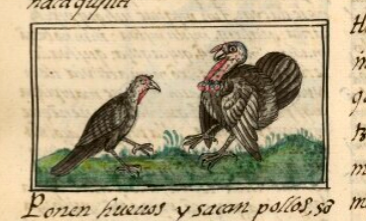
This iconographic example, featuring a turkey hen (totolin), is included in this digital collection for the purpose of making comparisons with related hieroglyphs. The term selected for this example comes from the Nahuatl text near the image in the Digital Florentine Codex. There is no gloss. This example shows a profile view (facing right) of what seems to be a turkey hen. She is standing, but her left foot is raised, suggesting that she is in motion. Her feathers are a mottled gray and black, with some faintly discernible stripes. She has a short snood, with small spiky feathers across the top of her head. Below her beak is a red wattle. She appears to wear a beaded necklace, made from small but graduated beads (not colored). Perhaps this necklace is symbolic of the caruncles that turkeys have at their necks naturally. Her claws appear long and sharp. The contextualizing image shows that she is facing a huexolotl (or huehxolotl), which is more obviously a male turkey, with large wings pointing downward and a large tail fan of feathers. The image of the totolin on folio 57r underlines that she is a female, because she is surrounded by her brood. The text notes that turkeys provide the best meat (food) of all birds native to this part of the world.
Stephanie Wood
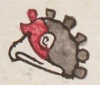
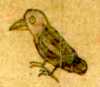
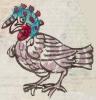
The simple term totolin is the most common name in the collection, and this may refer to a hen more than a cock. Huexolotl is a distant second. Sometimes the whole bird is shown, and often just the head. See some examples below.
Stephanie Wood

Totoli
totolin
Stephanie Wood
1577
Jeff Haskett-Wood
ave, aves, pavos, guajolotes, gallina, gallinas, carne de pavo, comida
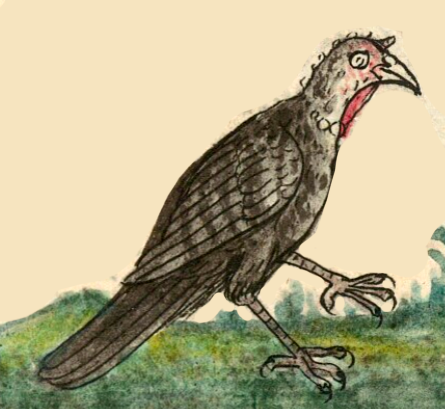
totol(in), a turkey, here perhaps a turkey hen, https://nahuatl.wired-humanities.org/content/totolin
el pavo, el guajolote norteño
Stephanie Wood
Available at Digital Florentine Codex/Códice Florentino Digital, edited by Kim N. Richter and Alicia Maria Houtrouw, "Book 11: Earthly Things", fol. 56v, Getty Research Institute, 2023. https://florentinecodex.getty.edu/en/book/11/folio/56v/images/0 Accessed 16 October 2025.
Images of the digitized Florentine Codex are made available under the following Creative Commons license: CC BY-NC-ND (Attribution-NonCommercial-NoDerivs 4.0 International). For print-publication quality photos, please contact the Biblioteca Medicea Laurenziana ([email protected]). The Library of Congress has also published this manuscript, using the images of the World Digital Library copy. “The Library of Congress is unaware of any copyright or other restrictions in the World Digital Library Collection. Absent any such restrictions, these materials are free to use and reuse.”